OS
Olyver SturdivantAI Ortho: How Artificial Intelligence Is Reshaping Orthodontic Clinics in 2026
Key Takeaways
- AI in orthodontics now spans two distinct categories: clinical tools (ceph tracing, treatment simulation, remote monitoring) and operational tools (phone answering, scheduling, insurance verification, patient intake)
- Most orthodontic clinics lose more revenue to front desk inefficiency than to clinical gaps — AI that handles calls, verifies insurance, and books appointments addresses the bigger financial leak
- Orthodontic-specific PMS integration is the dividing line between AI tools that actually work in ortho and generic dental solutions that create more manual cleanup
- The clinics adopting AI fastest are not chasing the flashiest tools — they are automating the repetitive operational work that burns out staff and loses patients
Search for "AI ortho" in 2026 and you will find hundreds of articles about cephalometric landmark detection, automated treatment planning, and machine learning models that predict tooth movement. Those are real advances. They matter.
But they are not what most orthodontic clinics are struggling with right now.
The more urgent problem, the one that costs practices patients and revenue every single week, is operational. Phones ring during lunch and go to voicemail. New patient calls come in after 5 PM and never get returned. Insurance verification takes 15 minutes per patient and still produces errors. Scheduling requires three back-and-forth calls to confirm a single appointment.
This is the other half of AI in orthodontics. Not the clinical side. The operational side. And for most clinics, it is where AI can create the most immediate, measurable impact.
This article covers both categories of AI in orthodontics: clinical and operational. It explains what each tool actually does, where the real ROI sits, and how to evaluate what your clinic needs most.
Clinical AI in Orthodontics: What Has Actually Shipped
Clinical AI in orthodontics has been in development for over a decade, but the tools that have reached production are concentrated in a few specific areas.
Cephalometric analysis is the most mature application. AI systems can now identify anatomical landmarks on lateral cephalograms with accuracy that matches or exceeds the average clinician. Companies like CephX and Diagnocat have shipped commercial products. Multiple peer-reviewed studies confirm that these tools reduce tracing time from several minutes to under 30 seconds while maintaining clinically acceptable precision.
The practical value is real but bounded. Ceph tracing was never the bottleneck in most clinics. An experienced orthodontist can trace a ceph in a few minutes. AI makes it faster, but the time savings are modest in absolute terms.
Treatment simulation and aligner staging is where clear aligner companies have invested most heavily. clear aligners's ClinCheck, SoftSmile Vision, and similar platforms use AI to predict tooth movement and generate staging sequences. These tools have become core to the aligner workflow and are now standard in practices doing significant aligner volume.
Remote monitoring through platforms like Dental Monitoring uses AI to analyze patient-submitted photos and flag cases that need attention. This is particularly relevant for aligner practices managing large patient panels. The AI identifies tracking issues, attachment problems, and compliance concerns without requiring an in-office visit.
Diagnostic imaging analysis is the newest frontier. AI tools can now identify pathology on panoramic radiographs and CBCT scans, including caries, periapical lesions, and bone loss. Overjet is the most visible company in this space. The FDA has approved a small number of AI-powered dental imaging devices, though the number specific to orthodontics remains limited.
What all these clinical tools have in common is that they augment the orthodontist's clinical judgment. None of them replace it.
Operational AI in Orthodontics: Where the Money Actually Moves
Here is a number that should get every clinic owner's attention: the average orthodontic clinic loses 30 to 40 percent of inbound new patient calls to voicemail, hold times, or after-hours timing. At an average case value of $5,000 to $6,000, even five lost new patients per month represents $25,000 to $30,000 in missed revenue from unanswered calls.
Clinical AI does not fix this. A faster ceph trace does not help if the patient never makes it to the exam chair because nobody answered the phone.
Operational AI for orthodontic clinics addresses the administrative and communication workflows that sit between the patient's first contact and their first appointment. The key categories include:
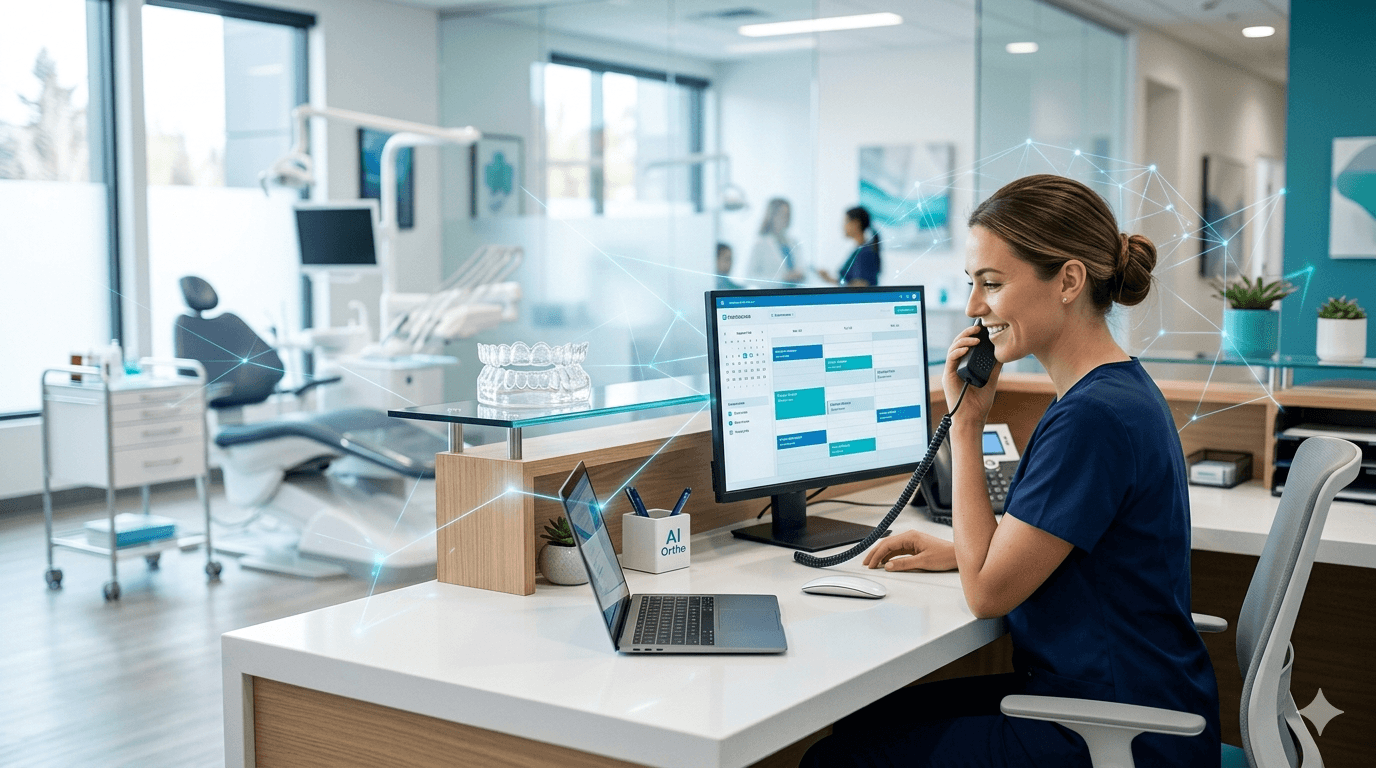
AI phone answering and scheduling. Voice AI systems answer inbound calls 24/7, handle new patient intake, answer common questions about office hours and services, and book appointments directly into the practice management system. The critical distinction is between systems that merely take messages and systems that actually write to the PMS calendar. Message-taking AI creates more work for staff. Direct-booking AI eliminates it.
Insurance verification. Manual insurance verification is one of the highest-cost, lowest-value tasks in any orthodontic front desk. A single verification can take 10 to 20 minutes of staff time through payer portals, and orthodontic verification costs more than most clinics realize. AI-powered verification can pull eligibility data in seconds and surface coverage details including deductibles, maximums, and orthodontic-specific benefits before the patient arrives.
Patient communication workflows. Automated appointment confirmations, recall reminders, and treatment follow-up messages reduce no-show rates and keep the schedule full without requiring staff to make dozens of manual calls per day.
Patient intake and lead capture. When a new patient calls or chats, AI can capture demographics, insurance information, referral source, and reason for visit in a structured format, then route that information into the PMS.
The financial impact of operational AI is not theoretical. Practices that answer every inbound call, verify insurance before the first visit, and confirm appointments automatically see measurable improvements in new patient conversion rates, case acceptance, and schedule utilization.
Why Orthodontic-Specific Matters More Than "Dental AI"
A common mistake practices make when evaluating AI tools is treating orthodontics like general dentistry. The workflows are different. The PMS landscape is different. The scheduling logic is different.
General dental clinics typically run on Dentrix, Eaglesoft, or Open Dental. Orthodontic clinics run on Cloud 9, Dolphin, or Ortho2 — each with distinct strengths and limitations. These systems have different APIs, different data structures, and different scheduling paradigms. An AI tool that integrates deeply with Dentrix but only sends email notifications to Cloud 9 is not solving the problem for an orthodontic clinic. It is creating a new one.
Orthodontic scheduling is also more complex than general dental scheduling. Appointments vary by type (new patient exam, records, bonding, adjustment, deband), by duration, by provider, and by chair availability. An AI scheduling system that does not understand this logic will either book incorrectly or default to message-taking, which defeats the purpose.
Insurance verification in orthodontics involves lifetime maximums, age limits, waiting periods, and coverage percentages that differ from preventive or restorative benefits. An AI verification tool needs to pull orthodontic-specific benefit data, not just confirm that a patient has active coverage.
The clinics getting the best results from AI are choosing tools built for orthodontic workflows specifically, not generic dental or healthcare AI platforms adapted with cosmetic changes. Orthia was built from the ground up for this reason — native integration with Cloud 9, Dolphin, and Ortho2, orthodontic scheduling logic, and ortho-specific insurance verification.
How to Evaluate AI Tools for Your Orthodontic Clinic
Start with the problem, not the technology. If your biggest revenue leak is missed calls, an AI phone system will generate faster ROI than an AI ceph tracer. If your treatment coordinators are spending two hours per day on insurance calls, AI verification pays for itself in the first week. Map your actual bottlenecks before evaluating any vendor.
Ask about PMS integration depth. The single most important question for any operational AI tool is whether it reads from and writes to your specific practice management system in real time. "We integrate with most dental software" is not an answer. You need to know: does it book appointments directly into Cloud 9/Dolphin/Ortho2? Does it pull insurance data from the PMS? Does it create patient records automatically?
Test with real calls, not demo scripts. Any AI phone system will sound perfect on a scripted demo. The real test is how it handles a patient who rambles, changes their mind, asks about insurance and then pivots to directions, or speaks with an accent. Ask the vendor to let you call the system cold, as a patient would.
Calculate ROI against a specific metric. "It saves time" is not an ROI case. "We were missing 12 new patient calls per month, each worth $5,500 in average case value, and now we capture 10 of them" is an ROI case. That is $55,000 in recovered revenue per month against a tool that costs $300 to $500 per month.
Ask about HIPAA compliance specifically. Any AI tool handling patient data must sign a BAA with your clinic. All data must be encrypted in transit and at rest. Ask where data is stored, who has access, and what happens to call recordings and transcripts.
The Near-Term Future
AI in orthodontics is not going to plateau. On the clinical side, expect tighter integration between imaging AI and treatment planning software. Remote monitoring will become more accurate and widely adopted.
On the operational side, the biggest shift will be AI systems that handle multi-step workflows end to end. Instead of separate tools for phone answering, insurance verification, and scheduling, practices will adopt platforms that handle all three in a single interaction. A new patient calls, the AI answers, verifies their insurance in real time, and books an appropriate appointment slot — all in one phone call without human intervention.
The clinics that move first on operational AI will have a compounding advantage. Every month of captured calls, verified insurance, and automated scheduling builds a revenue and efficiency gap that becomes harder for slower-moving competitors to close.
Sources: ADA Health Policy Institute; PMC/NIH: "Application of Artificial Intelligence in Orthodontics" (2023); Journal of Clinical Medicine: "AI in Orthodontics" (2024); Dental Economics technology adoption survey (2025); OpenLoop Health dental automation trends (2026).
Frequently Asked Questions
AI ortho refers to the application of artificial intelligence across orthodontic clinic operations and clinical workflows. This includes clinical tools like automated cephalometric analysis and treatment simulation, as well as operational tools like AI phone answering, automated insurance verification, and intelligent appointment scheduling. The term covers any AI technology designed specifically for or adapted to orthodontic clinic needs.
No. AI in orthodontics functions as a decision-support and automation layer. Clinical AI tools help orthodontists analyze data faster, but every treatment decision remains with the clinician. Operational AI handles repetitive administrative tasks like answering phones and verifying insurance, freeing staff to focus on patient care.
Clinical AI assists with diagnosis and treatment — ceph tracing, treatment outcome prediction, aligner staging, remote monitoring. Operational AI handles the business side — phone answering, scheduling, insurance verification, patient communication. Most clinics see faster ROI from operational AI because it directly impacts revenue capture and staff efficiency.
Some do, many do not. Most AI dental tools are built for general dental PMS platforms like Dentrix and Eaglesoft. Orthodontic clinics need tools with native integration to Cloud 9, Dolphin, Ortho2, or other ortho-specific systems. Always verify that any AI tool can read from and write to your specific PMS.
Clinical AI tools range from free (included with imaging hardware) to several hundred dollars per month. Operational AI tools like AI phone answering and scheduling typically cost $200-$800/month. The ROI on operational tools is usually measurable within the first month based on recovered missed calls and reduced staff time.
AI tools handling patient data must comply with HIPAA. The vendor must sign a BAA, encrypt all data in transit and at rest, maintain access controls and audit logs, and store data in secure U.S.-based infrastructure. Always verify compliance before signing with any vendor.
OS
Olyver Sturdivant
Contributing writer at Orthia AI.