OS
Olyver SturdivantAI Receptionist for Orthodontic Clinics: Complete 2026 Guide
Key Takeaways
- 30-35% of calls to orthodontic clinics go unanswered during business hours, per Weave, CallRail, and Peerlogic data
- Each missed orthodontic new patient call represents $3,000-$8,000 in potential case revenue
- 62% of dentists cite staffing as their number one challenge heading into 2025-2026
- 75% of patients who reach voicemail never call back, and 67% immediately call another clinic
- AI receptionists cost $200-$500/month versus $50,000-$60,000/year for a full-time employee
- Orthodontic insurance verification, multi-visit scheduling, and parent communication make generic AI a poor fit
- The strongest use case in 2026 is after-hours and overflow coverage, not full front desk replacement
Your orthodontic clinic is missing about a third of its incoming calls. That is not a guess. Data from Weave Communications, CallRail, and Peerlogic consistently shows that 30 to 35 percent of calls to orthodontic and dental offices go unanswered during business hours. In general dentistry, each missed new patient call costs roughly $850. In orthodontics, where the average case runs $3,000 to $8,000, the math is significantly worse. An AI receptionist for orthodontic clinics is no longer a novelty. It is a direct response to a staffing crisis, a patient behavior shift, and an economic reality that most clinic owners have not fully quantified.
This guide covers what AI receptionists actually do in 2026, why orthodontic clinics have needs that generic dental solutions cannot meet, the real costs and tradeoffs, and how to evaluate whether one makes sense for your clinic.
Why Orthodontic Clinics Are Losing Patients on the Phone
The front desk problem in orthodontics is structural, not just operational. Your team is not underperforming. The job has become impossible to do well under current conditions.
The staffing crisis is real and getting worse
The ADA Health Policy Institute reported in early 2025 that 62% of dentists named staffing as their biggest challenge. That tracks with broader data showing 76% of clinics experienced staff turnover in 2023 alone, according to the Dental Economics/Levin Group Annual Practice Survey. Front desk roles are among the hardest to fill. The DentalPost 2025 Salary Report, based on over 3,500 respondents, found that nearly 30% of front office associates changed employers in 2024, and 28% planned to apply for new jobs in 2025.
The math behind the problem is simple. Front desk staff in orthodontic and dental offices earn between $38,000 and $47,000 per year on average. Factor in benefits, payroll taxes, and training, and total employment cost lands between $50,000 and $60,000 per year per person. Vacant positions stay open for an average of 47 days. Every day that seat is empty, calls go unanswered.
As Beverly Wilburn, an AADOM member and clinic manager, described after pulling her own call reports: she found 29% of calls on a single day went straight to voicemail. She described being shocked at the number. Most clinic owners have never looked.
Patient behavior has shifted
Patients do not leave voicemails anymore. DenteMax reports that only 14% of new patients will leave a message. The rest hang up and move on. Industry data from multiple sources suggests that roughly 75% of patients who miss a live answer will never call back.
The timing of calls matters too. Somewhere between 28% and 47% of patient calls come in outside of standard 9-to-5 business hours, depending on whether you include lunch breaks, early mornings, and late afternoons in that window. Monday mornings generate about 40% more volume than an average weekday. Peak hours during the day cluster between 9 and 11 AM and again from 2 to 3 PM, which happen to be the exact windows when your front desk is busiest with in-office patients.
The orthodontic-specific multiplier
General dentistry practices lose roughly $850 per missed new patient call. That number comes from the average first-year value of a general dental patient. In orthodontics, the stakes are four to ten times higher. The average orthodontic case is worth $3,000 to $7,000 for traditional braces and $3,000 to $8,000 or more for clear aligners. CareCredit research pegs the average clear aligners case around $5,100.
Missing five new patient calls per month, which is well within the normal range for a clinic with a 30% missed call rate and 50-plus daily calls, could mean $15,000 to $40,000 in lost production per month from missed calls alone. Over a year, that is $180,000 to $480,000 walking out the door, or more accurately, never walking in.
What an AI Receptionist Actually Does in 2026
The term "AI receptionist" covers a wide range of capabilities, and the difference between the best and worst products on the market is enormous. Here is what the current generation of AI receptionist tools can and cannot do for an orthodontic clinic.
What they handle well
The strongest use case in 2026 is answering calls when your team cannot. That means after hours, during lunch, during peak volume, and when your front desk is helping a patient in person. A well-configured AI receptionist can answer the phone within one ring, 24 hours a day, 7 days a week. No hold time. No voicemail.
For routine tasks, the technology has matured significantly. Current AI voice systems handle appointment scheduling for standard visit types, answer common questions about office hours, location, and accepted insurance, capture new patient contact information and route leads to your team, confirm and reschedule existing appointments, and respond in both English and Spanish with natural-sounding conversation.
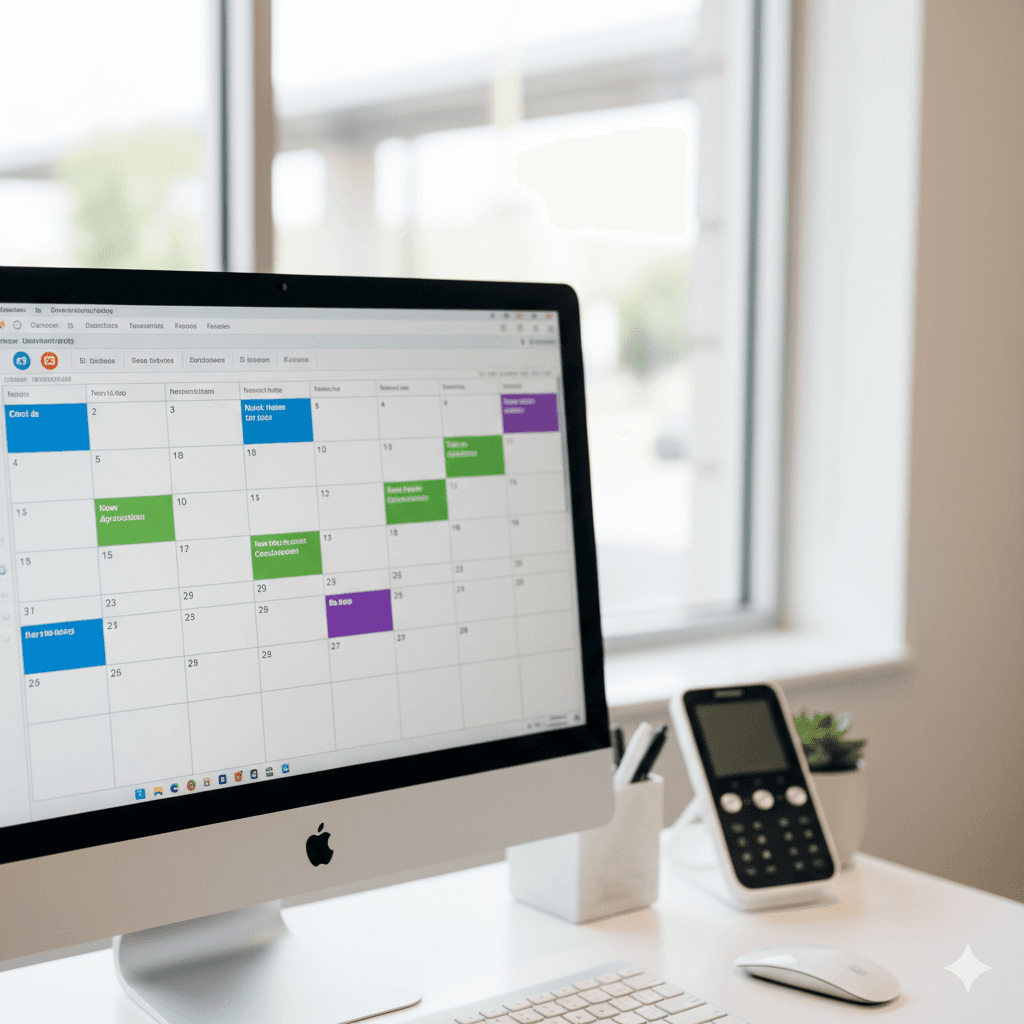
The best dental-specific platforms, including Orthia, integrate directly with practice management systems like Cloud 9, Dolphin, and Ortho2. That means the AI is not just taking messages. It is checking real-time availability and booking directly into your schedule.
What they still struggle with
Honesty about limitations matters more than hype. AI receptionists in 2026 still have trouble with several important scenarios. Complex insurance questions that require nuanced interpretation of orthodontic benefits, lifetime maximums, and age limitations are not reliably handled by most systems. Emotional conversations with anxious patients, frustrated parents, or patients dealing with payment difficulties still require a human touch. Detailed clinical triage beyond basic emergency categorization needs human judgment in many cases.
A DentalTown forum user described the experience bluntly: patients got frustrated repeating their names and dates of birth, and the AI could not understand them reliably enough. That was one practice's experience with one product, but it reflects a real limitation that varies widely by vendor.
The critical distinction is between AI as a supplement and AI as a replacement. In 2026, the most successful implementations use AI to catch overflow and after-hours calls, then hand off complex situations to a human with full context from the AI conversation.
Why Orthodontic Clinics Need a Different Solution Than General Dental
Generic dental AI receptionists exist. Several companies sell them. But orthodontic clinics operate differently from general dental offices in ways that matter for phone handling. If your AI does not understand these differences, it will create more problems than it solves.
Appointment types are radically different
A general dental office mostly schedules cleanings, exams, and fillings. The time slots are relatively uniform. An orthodontic clinic juggles at least eight distinct appointment types, each with a different duration. New patient exams run 30 to 60 minutes. Records appointments take 30 to 45 minutes. Bonding appointments need one to two hours. Adjustment checks are 15 to 30 minutes. Debond appointments run about 80 minutes. Retainer checks are 15 to 20 minutes. Emergency repairs for broken brackets or poking wires need 15 to 30 minutes of buffer time. Treatment coordinator consultations add another 20 to 30 minutes.
An AI that does not understand the difference between scheduling a 15-minute adjustment and a two-hour bonding appointment will wreck your schedule. This is not a theoretical concern. It is the most common failure mode when practices try to use generic scheduling tools.
Insurance verification is fundamentally different
Orthodontic insurance does not work like general dental insurance. Orthodontic benefits use lifetime maximums instead of annual maximums, typically ranging from $1,000 to $3,000. Once that benefit is used, it is gone permanently. Coverage is usually 50% of treatment cost up to the lifetime cap. Insurance pays an initial lump sum of 25 to 40% at the start of treatment, then installments over 18 to 24 months.
Many plans restrict coverage to dependents under 19, with some extending to age 26. Waiting periods can run 6 to 24 months from enrollment. Verifying orthodontic eligibility requires checking lifetime maximum, percentage coverage, remaining benefit, age limitations, waiting period status, network status, aligner coverage, dual coverage coordination, and pre-authorization requirements. A front desk AI that tells a parent their child has orthodontic coverage when the waiting period has not been met will create a trust problem you cannot undo.
Orthia handles insurance eligibility verification in real time, checking against orthodontic-specific benefit structures rather than applying general dental logic to orthodontic questions.
Treatment coordinator workflows need support, not replacement
Around 70% of orthodontic clinics employ a dedicated Treatment Coordinator. The TC is the person who turns a consultation into a signed contract. After the orthodontist spends five to eight minutes examining a new patient, the TC presents the treatment plan, explains the financial options, and works through insurance. Top-performing TCs achieve case acceptance rates above 85%.
The AI receptionist's job is to get that new patient into the TC's chair in the first place. That means capturing leads immediately, qualifying them (age of patient, type of concern, insurance carrier), and scheduling the right appointment type. It does not mean replacing the TC conversation.
Your patients are often minors
Most orthodontic patients are teenagers. The person calling is usually a parent or guardian, not the patient. This creates a communication dynamic that generic dental AI is not built for. The AI needs to understand that it is speaking with a responsible party about a dependent. It needs to handle situations where a parent is calling about scheduling for multiple children. It needs to route insurance questions to the correct responsible party rather than the minor patient.
AI Receptionist vs. Traditional Answering Services vs. Doing Nothing
Traditional answering services
Human answering services like Ruby and MAP Communications have been around for decades. They provide live operators who answer calls using your clinic's script. Pricing typically runs $150 to $1,200 per month depending on call volume, with per-minute billing between $0.75 and $1.75 per minute.
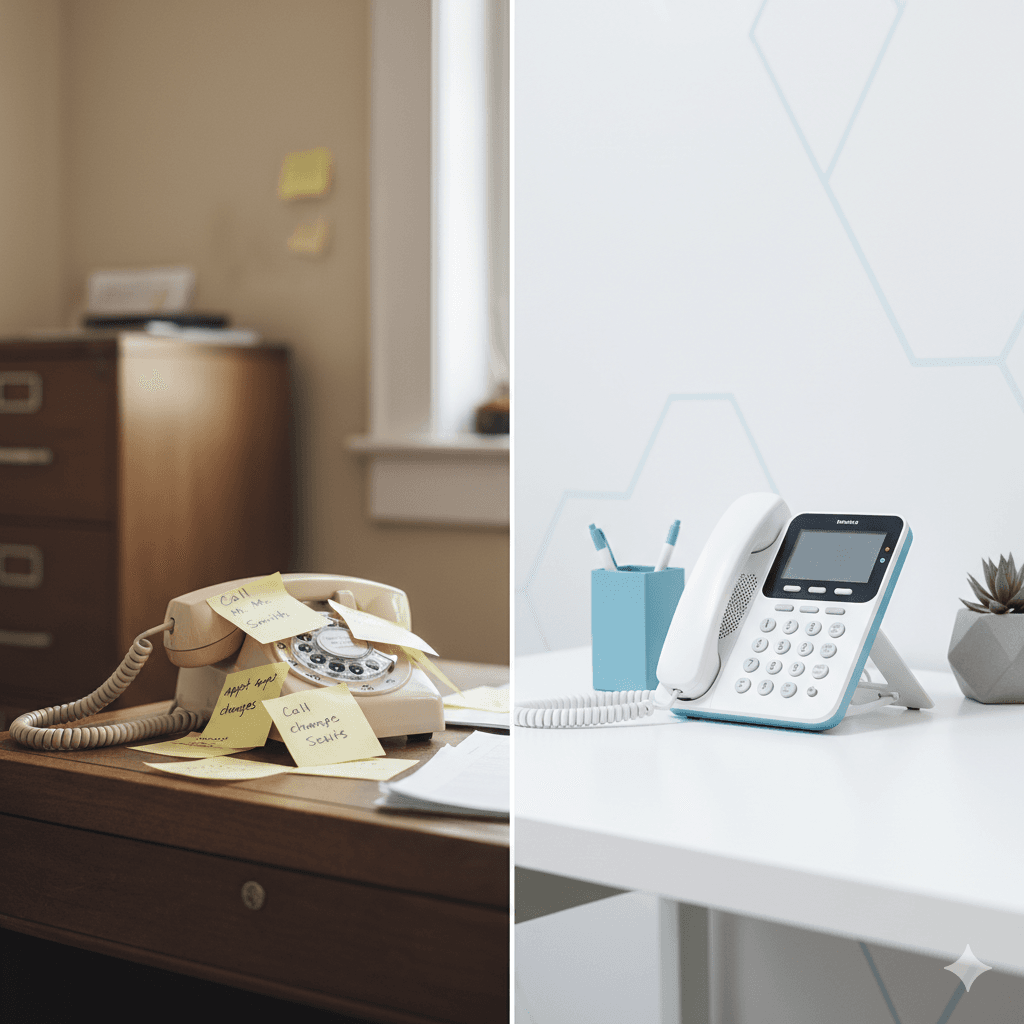
The limitations are significant for orthodontic clinics. These services cannot access your PMS, so they take messages rather than book appointments. They do not understand orthodontic terminology. They cannot verify insurance — and orthodontic insurance verification is fundamentally different from general dental. They handle one call at a time per agent. And cost escalation is a real risk.
For a busy orthodontic clinic generating 40 to 60 calls per day, a traditional answering service quickly becomes expensive without solving the core scheduling problem.
IVR and automated phone menus
The "press 1 for scheduling, press 2 for billing" approach is functionally dead for patient-facing use. Data consistently shows that patients hang up when directed to voicemail, and IVR systems are the fastest way to get them there. The future of patient communication is not better hold music or nicer phone trees. It is eliminating the distinction between the phone system and the scheduling system entirely.
AI receptionists
AI receptionist platforms for dental and orthodontic clinics generally cost between $200 and $500 per month. That is roughly $2,400 to $6,000 per year versus $50,000 to $60,000 for a full-time employee. The AI answers every call instantly, operates 24/7, handles multiple simultaneous calls, and when properly integrated, books directly into your schedule.
The tradeoff is capability depth. AI handles routine interactions well but falls short on complex, emotional, or ambiguous situations.
The cost of doing nothing
This is the option most clinics implicitly choose. They are missing 30 to 35% of calls and have never quantified the revenue impact. For an orthodontic clinic, doing nothing means accepting that five to fifteen new patient calls per month go unanswered. At an average case value of $5,000 and a 60% case acceptance rate, that is $15,000 to $45,000 in potential production lost per month.
The patient acquisition cost for orthodontic clinics runs $300 to $600 per patient — and as we explore in our breakdown of cost per acquisition for orthodontic patients, you are paying that marketing cost whether the phone gets answered or not.
How to Evaluate an AI Receptionist for Your Practice
Not all AI receptionists are built the same. Here is how to separate the real products from the resellers.
Questions to ask every vendor
Does the system integrate directly with my PMS? Ask for a live demo showing a call being answered, an appointment being booked, and that appointment appearing in your actual practice management system in real time. If the vendor says integration is "coming soon" or requires your staff to manually enter appointments from a dashboard, that is not integration.
Can the system handle different appointment types and durations? Schedule a test call and try to book a new patient exam, then an adjustment appointment, then an emergency bracket repair. If the system treats all three the same way, it will not work for orthodontics.
Is the vendor HIPAA compliant with a signed BAA? Every AI receptionist vendor that handles patient calls is a business associate under HIPAA and must sign a Business Associate Agreement. Ask specifically: does the vendor use call recordings to train models for other clients? Is data encrypted at rest and in transit? What is the breach notification timeline?
What happens when the AI cannot handle a call? The best systems transfer complex calls to your team with full conversation context. The worst systems leave the patient in a loop or drop the call. Test the failure mode, not just the success case.
What is the actual pricing after all add-ons? Some platforms quote a low base price, then charge extra for PMS integration, additional phone lines, bilingual support, or call recording. Get the all-in monthly cost for your clinic's call volume.
Red flags to watch for
Vendors that will not let you hear the AI voice before signing a contract. Case studies that only come from the vendor's own website with no independent verification. Claims of "99% accuracy" without defining what accuracy means. Pricing that requires an annual commitment with no trial period. No specific mention of dental or orthodontic use cases on their website.
Implementing an AI Receptionist Without Disrupting Your Practice
The clinics that succeed with AI receptionists follow a consistent pattern. They start narrow, measure results, and expand gradually.
Start with after-hours and overflow
The lowest-risk, highest-return implementation is having AI answer calls that would otherwise go to voicemail. After hours, during lunch, and when your entire front desk team is occupied with in-office patients. This captures calls you are currently missing entirely, so the only possible outcome is improvement.
Orthia is built specifically for this orthodontic use case. It picks up calls your team cannot get to, captures the lead, books into your PMS, and hands off complex questions to your staff the next business day with complete call context.
Prepare your team
Front desk staff often worry that AI means their job is being eliminated. In almost every successful implementation, the opposite happens. The AI handles the repetitive, high-volume calls so your team can focus on complex patient interactions, treatment coordinator follow-ups, and insurance verification.
Have the conversation with your team before the technology goes live. Frame it as removing the worst part of their job, not removing their job.
Track the right metrics
The numbers that matter after implementing an AI receptionist are total calls answered versus total calls received, new patient leads captured after hours, appointments booked by AI versus appointments that required human follow-up, patient complaints or negative feedback specifically about the AI interaction, and revenue from patients who were captured outside business hours.
Do not measure success by how impressed you are with the technology. Measure it by whether more patients are getting through and more appointments are getting booked.
Give it 60 to 90 days
AI receptionists improve with training data. The first two weeks will surface edge cases and mishandled calls. The best vendors will actively tune the system based on your feedback. If a vendor installs and disappears, that is a problem. Expect weekly check-ins during the first month and monthly reviews after that.
What AI Receptionists Cannot Replace in Orthodontics
A clear-eyed assessment of limitations matters more than promises.
AI will not replace your Treatment Coordinator. The TC conversation is a consultative, empathetic, high-stakes interaction where a parent is deciding to invest thousands of dollars in their child's smile. AI is not doing that in 2026.
AI will not replace your clinical triage. When a patient calls in a panic about a wire poking their cheek, a human who understands the difference between "this can wait until Monday" and "come in now" is still essential.
AI will not handle angry patients well. If someone is upset about a bill, a scheduling error, or a clinical outcome, they need a person who can listen, empathize, and problem-solve. Routing an angry patient to a bot makes the situation worse.
The most realistic and honest framing is this: AI receptionists are the best team member you have ever had for the tasks that require speed, consistency, and availability. They are the worst team member you could have for tasks that require empathy, judgment, and improvisation. Use them accordingly.
The Bottom Line
The orthodontic front desk problem is not going away. Staffing shortages are structural. Patient expectations for immediate response are increasing. And every unanswered call represents $3,000 to $8,000 in potential revenue walking to the clinic down the street.
AI receptionists are not perfect. The technology has real limitations, and the market includes both serious products and repackaged off-the-shelf tools. But for the specific problem of answering calls that currently go to voicemail, capturing new patient leads after hours, and handling routine scheduling during peak volume, the technology works. The clinics that implement it thoughtfully, starting with overflow and measuring results, are capturing patients that their competitors are losing.
The question is not whether your clinic will eventually adopt some form of AI-assisted communication. It is whether you will do it before or after your competitors.
Sources: ADA Health Policy Institute (2025), Weave Communications, CallRail, Peerlogic/Scheduling Institute, TrueLark, DentalPost 2025 Salary Report, Dental Economics/Levin Group 2024 Survey, Dentplicity 2026 Benchmarks, Salary.com, Indeed, DenteMax, CareCredit/ASQ360° Research.
Frequently Asked Questions
Modern AI voice agents have sub-100-millisecond response times and natural speech patterns. Some patients may notice on longer calls. The best approach is transparency — many clinics include a brief disclosure at the start of after-hours calls. Patients care far more about getting their question answered quickly than about who answered.
It can be, but compliance depends on the vendor. Any AI system handling patient calls must sign a BAA. Look for end-to-end encryption (TLS 1.3 in transit, AES-256 at rest), role-based access controls, audit logging, and clear breach notification policies. Ask whether call recordings are used to train models for other clients.
Most dental AI receptionists charge $200-$500/month. A full-time front desk employee costs $50,000-$60,000 annually, and traditional answering services run $150-$1,200/month with no scheduling capability. Even capturing one additional new patient per month at a $5,000 average case value more than covers the cost.
Some AI receptionists can, but many cannot. This is the most important question to ask any vendor. True integration means the AI checks real-time availability in your specific PMS and books during the call. Verify with a live demonstration, not a sales deck.
For most orthodontic clinics in 2026, overflow and after-hours coverage is the right starting point. Let the AI prove itself on calls you are currently missing before expanding its role.
Scheduling errors will happen in the first few weeks as the system learns your rules. The best vendors include human review for complex bookings and provide a dashboard to catch errors. Your front desk should review AI-booked appointments daily during initial implementation.
OS
Olyver Sturdivant
Contributing writer at Orthia AI.