OS
Olyver SturdivantAI Receptionist vs. Traditional Answering Service for Orthodontists
Key Takeaways
- Traditional answering services cost $800-$2,000/month and cannot book appointments or access your PMS
- Additional in-house staff costs $50,000-$60,000/year fully loaded and is limited to business hours
- AI receptionists start at $200-$500/month with 24/7 coverage and direct PMS integration
- Generic AI receptionists miss ortho-specific workflows — specialization is critical
- The ideal 2026 setup combines AI handling overflow and after-hours with human staff for complex situations
- Per-minute answering service billing can escalate unpredictably for high-volume practices
- Only AI receptionists can handle unlimited simultaneous calls — humans and services cannot
Three Options for Handling Patient Calls in 2026
Orthodontic clinics that want to stop missing calls typically evaluate three options: hiring additional front desk staff, outsourcing to a traditional answering service, or implementing an AI receptionist. Each has distinct tradeoffs in cost, capability, coverage, and quality. The right answer depends on your clinic size, call volume, and growth stage — but the data strongly favors one approach for most clinics.
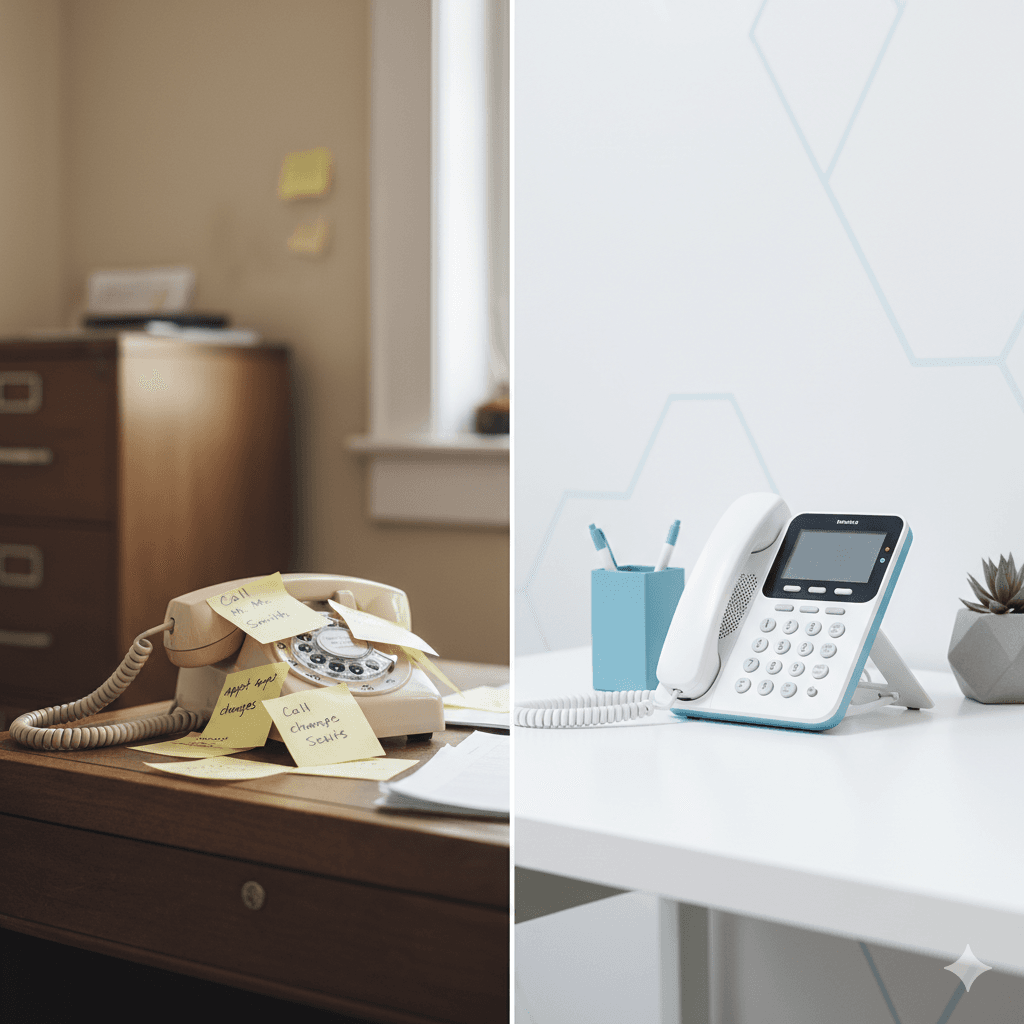
Traditional Answering Services: The Legacy Approach
Live answering services like Ruby, MAP Communications, and PatientCalls have been serving dental clinics for decades. They employ human operators who answer calls using your clinic's script, take messages, and sometimes transfer calls to on-call staff.
What they cost
Pricing typically runs $0.75 to $1.75 per minute, with monthly minimums of $150 to $300. For an orthodontic clinic receiving 40 to 60 calls per day with an average call duration of 3 minutes, monthly costs land between $800 and $2,000. High-volume practices or those with longer average call times can see bills exceed $3,000 per month. Cost escalation is a real risk with per-minute billing — one busy Monday can blow your budget.
What they cannot do
The limitations are significant for orthodontic clinics specifically. Operators have no access to your practice management system and cannot book appointments. They take messages that your staff must manually process the next day. They cannot verify insurance eligibility or benefits, and orthodontic insurance verification takes 10x longer than dental to begin with. They do not understand the difference between scheduling a 15-minute adjustment and a 2-hour bonding appointment. They follow generic scripts with no understanding of orthodontic terminology.
When a parent calls asking whether their child's expander adjustment is covered by their Delta Dental plan, the operator can only say "I'll have someone call you back." The patient experience feels disconnected from your clinic, and the lead goes cold.
Who they work for
Answering services still make sense for clinics that need human warmth on every call and have low call volumes (under 20 calls per day). For most growing orthodontic clinics, the cost-to-capability ratio no longer works.
Additional In-House Staff: The Expensive Safety Net
Hiring another front desk team member is the traditional solution. You get a real person who knows your clinic, can book appointments, and can answer detailed clinical and insurance questions.
What it actually costs
Base salary for orthodontic front desk staff runs $38,000 to $47,000 per year. Add employer payroll taxes (7.65%), health insurance ($5,000-$8,000/year), PTO, training time, and management overhead. Fully loaded cost: $50,000 to $65,000 annually, or roughly $4,200 to $5,400 per month.
Then factor in the hidden costs. The average front desk position stays vacant for 47 days. Nearly 30% of front office associates changed employers in 2024 according to the DentalPost Salary Report. Every turnover cycle means recruiting costs, training time, and weeks of reduced productivity.
The coverage gap
Humans work 8 hours a day, 5 days a week. They take lunch breaks, sick days, and vacations. They cannot answer calls at 7 PM when a parent finally has time to research braces for their teenager. They cannot handle three simultaneous calls during a Monday morning rush. Between 28% and 47% of patient calls come outside standard hours — your new hire misses all of them, and the revenue lost from those missed calls adds up faster than most clinics expect.
Who this works for
Additional staff makes sense when your in-office patient volume demands another body at the front desk for face-to-face interactions. But hiring another person purely to answer more phone calls is the most expensive way to solve the missed call problem.
AI Receptionists: The 2026 Standard
AI receptionists like Orthia operate 24/7 for a flat monthly fee between $200 and $500. That is roughly $2,400 to $6,000 per year versus $50,000 to $65,000 for an employee. But cost is only part of the story.
What they can do that others cannot
The key differentiator is not price — it is capability depth. A properly built AI receptionist answers every call within one ring, 24 hours a day. It handles unlimited simultaneous calls (no more busy signals during Monday morning rushes). It integrates directly with your PMS — Cloud 9, Dolphin, Ortho2, Dentrix, and 68+ others — to check real-time availability and book appointments during the call. It verifies insurance eligibility in real time. And it never calls in sick, takes lunch, or gives two weeks notice.
For orthodontic clinics specifically, Orthia understands the difference between scheduling types. It will not book a 15-minute adjustment into a bonding slot. It handles parent-to-dependent communication patterns. It triages emergencies by severity — routing a poking wire differently than a broken bracket or severe jaw pain.
What they still cannot do
Honesty matters here. AI receptionists in 2026 still struggle with complex insurance interpretation (lifetime max calculations, dual coverage coordination), emotionally charged conversations (upset parents, billing disputes), and nuanced clinical triage that requires experienced human judgment. These calls should always route to your team.
The ideal implementation
The clinics seeing the best results in 2026 use AI to catch every call that would otherwise go to voicemail — after hours, during lunch, during peak volume overflow — and hand off complex situations to human staff with full conversation context. This is not AI replacing your team. It is AI making your team's job possible.
Side-by-Side Cost Comparison
Traditional answering service: $800-$2,000+/month. No PMS access. Cannot book appointments. Cannot verify insurance. One call at a time per agent. Per-minute billing escalates unpredictably.
Additional staff member: $4,200-$5,400/month fully loaded. Limited to business hours. Subject to turnover (30% annual rate). Cannot handle simultaneous calls. 47-day average vacancy when they leave.
AI receptionist (Orthia): $399/month starting. 24/7 coverage. Direct PMS integration. Real-time insurance verification. Unlimited simultaneous calls. Ortho-specific appointment logic. No turnover.
Making the Decision for Your Practice
For solo orthodontic clinics and single-location offices doing 30 to 80 calls per day, an AI receptionist provides the best combination of coverage, capability, and cost. It handles the high-volume routine work — scheduling, insurance questions, hours, directions — while freeing your human staff to focus on the in-person patient experience, treatment coordinator conversations, and complex situations that genuinely require empathy and judgment.
For multi-location clinics and DSOs, AI front desk platforms become even more compelling. Consistent patient experience across locations, centralized call handling, and per-location cost savings compound quickly.
The clinics that are winning new patients in competitive markets — whether that is Dallas, Phoenix, Atlanta, or any metro area with 10+ orthodontists — are the ones that answer every call, every time. The technology to do that now costs less than a single day of a front desk employee's salary per month.
Frequently Asked Questions
Traditional answering services charge $0.75-$1.75 per minute. For a clinic receiving 50 calls/day with 3-minute average duration, this translates to $800-$2,000+ per month — and they cannot book appointments, access your PMS, or verify insurance.
No, and it should not try to. AI receptionists are designed to supplement your team by handling overflow, after-hours, and routine calls. Your staff focuses on in-person patient care, complex insurance, and treatment coordinator conversations that require human empathy.
Orthodontic clinics juggle 8+ distinct appointment types (bonding, adjustments, debonds, records, etc.), use lifetime insurance maximums instead of annual, and communicate primarily with parents about minor patients. Generic dental AI cannot handle these differences.
Reputable platforms like Orthia sign a BAA and use end-to-end encryption (TLS 1.3 in transit, AES-256 at rest). Ask every vendor specifically about their data handling, whether recordings train models for other clients, and their breach notification timeline.
The best systems transfer complex calls to your team with full conversation context — caller name, reason, and what was discussed. The worst systems loop or drop. Always test the failure mode before signing.
With Orthia, most clinics complete onboarding and go live in under one hour. The process involves a 15-minute clinic details form, a vendor-handled PMS connection, and a quick test before routing live calls.
OS
Olyver Sturdivant
Contributing writer at Orthia AI.