OS
Olyver SturdivantAI Front Desk for Orthodontic DSOs and Multi-Location Practices in 2026
Key Takeaways
- Orthodontic DSOs and multi-location groups lose more new patients to inconsistent phone handling than to marketing gaps. When five locations answer calls five different ways, conversion rates vary wildly and the weakest location drags down the entire organization.
- Centralized call centers solve consistency but introduce new problems: staffing costs, training overhead, lack of orthodontic-specific knowledge, and the inability to book directly into each location's PMS.
- AI front desk platforms offer DSOs a third option: standardized call handling across every location, direct PMS integration with Cloud 9, Dolphin, Ortho2, and Dentrix, and real-time insurance verification during the call.
- The ROI math for multi-location groups is different than for solo practices. A single-office practice saves one missed patient. A five-location DSO capturing two additional patients per location per month adds $660,000 in annual production.
- Most dental AI tools were not built for multi-location orthodontic operations. They lack tenant-level configuration, location-specific scheduling rules, and the PMS integrations that orthodontic DSOs actually use.
TL;DR: Orthodontic DSOs lose patients when each location answers calls differently. AI front desk platforms standardize call handling across every location, book directly into Cloud 9, Dolphin, and Ortho2, and verify orthodontic insurance during the call — at roughly $600/month per location versus $180K–$280K/year for a centralized call center.
The multi-location orthodontic phone problem
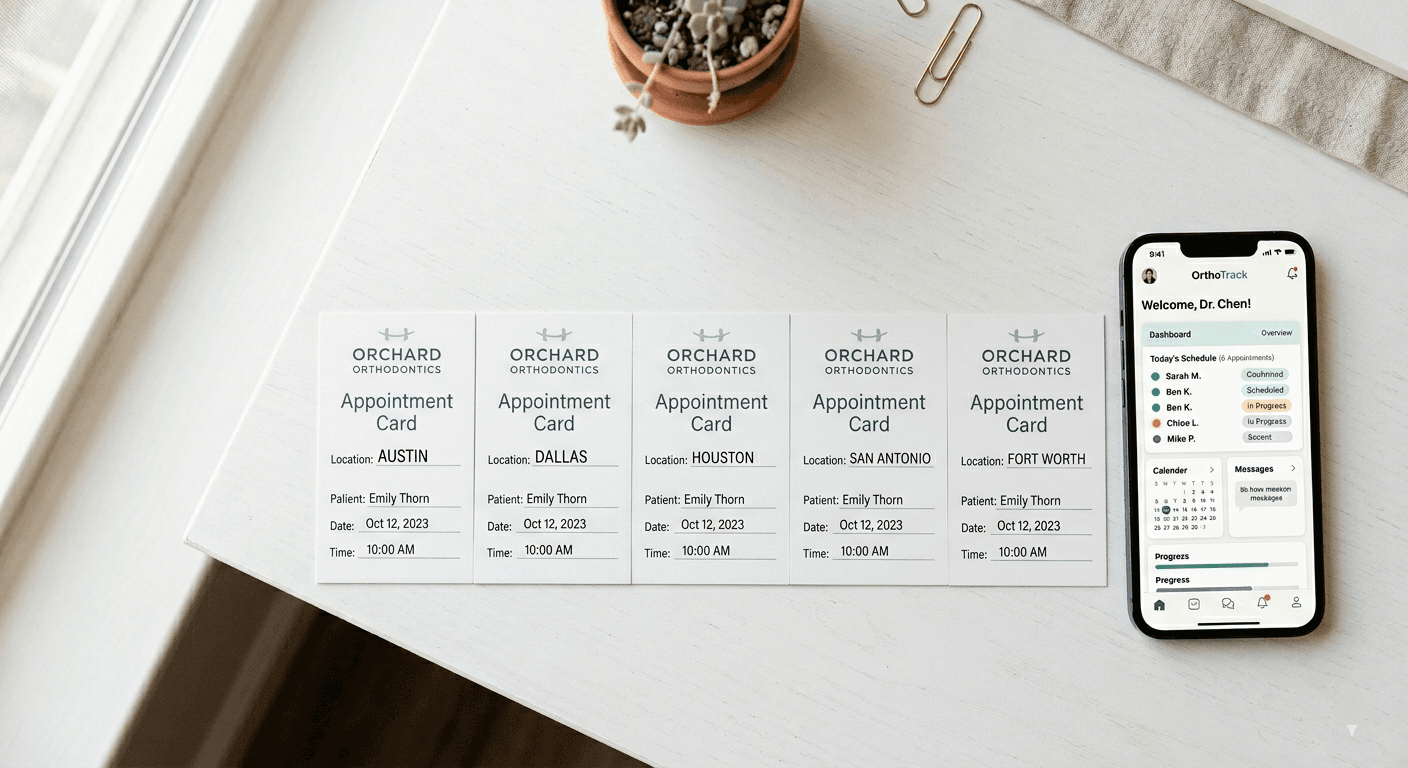
If you operate two or more orthodontic locations, you already know the feeling. One office answers calls quickly and converts well. Another office has a front desk team that is overwhelmed, undertrained, or just having a bad Tuesday. A third office misses calls during lunch because nobody covers the phone.
The result is not just lost patients at the weak location — and the real cost of a missed patient call in orthodontics compounds fast across a portfolio. It is a brand problem. When a parent calls your Southlake office and gets a polished experience, then calls your Frisco office and hits voicemail, they do not think "that one office has a phone issue." They think your organization has a phone issue.
This is the multi-location phone problem, and it gets worse the more locations you add.
Single-office orthodontic clinics have one phone culture. The doctor is usually close enough to hear how calls are handled. Problems get caught and corrected quickly. Multi-location groups, whether structured as a DSO, an OSO (orthodontic service organization), or simply a doctor who owns three offices, lose that direct oversight. The phone becomes a black box at every location you are not physically standing in.
Why Centralized Call Centers Only Partially Solve It
The obvious solution for orthodontic DSOs is to centralize phone answering. Route all inbound calls to a single team that handles scheduling, new patient intake, and basic inquiries for every location.
This works better than nothing. But it creates its own set of problems.
Staffing costs scale linearly. Every new location adds call volume. A five-location orthodontic group generating 150 to 200 inbound calls per day needs four to six dedicated phone agents, plus coverage for breaks, lunch, PTO, and turnover. At $18 to $22 per hour loaded, that is $180,000 to $280,000 annually in call center labor alone.
Training never ends. Each location has its own scheduling rules, provider availability, appointment type logic, and patient communication preferences. A centralized agent needs to know the difference between a Phase 1 consultation at your downtown location versus a records appointment at your suburban location. When providers change schedules, the call center needs to be updated in real time. This is where mistakes happen.
PMS access becomes a bottleneck. If your locations run Cloud 9, your call center agents need Cloud 9 access for each location. If one location runs Dolphin and another runs Ortho2, your agents are now toggling between multiple PMS platforms that each have different capabilities on every call. This is not theoretical. It is the daily reality for orthodontic groups that have grown through acquisition, where each acquired practice brought its own software.
After-hours coverage is expensive. A centralized call center during business hours still leaves evenings, weekends, and holidays uncovered. Extending coverage to 24/7 doubles or triples staffing costs. Most groups compromise by using a generic answering service after hours, which takes messages but does not book appointments, verify insurance, or answer orthodontic-specific questions.
AI Front Desk vs. Centralized Call Center vs. Status Quo
| Capability | No Coverage (Status Quo) | Centralized Call Center | AI Front Desk (Orthia) | |---|---|---|---| | After-hours coverage | None | Limited or expensive | 24/7 included | | Cost for 5 locations | $0 (lost revenue) | $180K–$280K/year | ~$36K/year | | PMS booking | N/A | Manual, error-prone | Direct, real-time | | Orthodontic insurance verification | Manual, next day | Manual, during call | Automated, during call | | Consistency across locations | None | Moderate | Identical every call | | Multi-PMS support (Cloud 9 + Dolphin) | N/A | Requires training per system | Native integration | | Scalability per new location | Hire more staff | Hire more agents | Add configuration | | Setup time per location | N/A | 2–4 weeks training | Under 1 day |
What AI Front Desk Platforms Actually Do for Multi-Location Groups
An AI front desk platform for orthodontic DSOs is not a chatbot. It is not an answering service that takes messages. It is an AI system that answers inbound calls with a natural-sounding voice, identifies whether the caller is a new or existing patient, and completes the call by booking an appointment, answering a question, or routing to the appropriate person.
For multi-location groups, the critical capability is location-level configuration. Each location gets its own scheduling rules, provider availability, appointment types, and communication preferences while the DSO maintains centralized oversight across all locations.
Here is what that looks like in practice:
Location-specific scheduling logic. Your Manhattan location offers Saturday consultations. Your Brooklyn location does not. The AI knows this and only offers Saturday availability when the caller is routed to or calls the Manhattan location. Appointment durations, provider assignments, and scheduling buffer rules are configured per location.
Direct PMS integration per location. If your Dallas office runs Cloud 9 and your Fort Worth office runs Ortho2, the AI integrates with both. It reads real-time schedule availability from each location's PMS and books directly into the correct system. No double-entry. No manual transfer. The appointment appears in the PMS exactly as if a front desk team member had entered it.
Standardized call quality across every location. The AI does not have bad days. It does not rush through calls when the waiting room is full. It does not forget to ask about insurance. Every call at every location follows the same protocol: greet the patient, identify their need, collect required information, and complete the task. This consistency is what DSO operators care about most.
Real-time insurance verification. During the call, the AI can verify both dental and orthodontic insurance eligibility and benefits. For orthodontic DSOs, this means checking lifetime maximums, remaining benefits, age eligibility, and coverage specifics before the patient even walks in — a process that normally takes 10x longer than it should when done manually. This saves treatment coordinator time and reduces financial surprises at the consultation.
Centralized reporting. The DSO operations team sees call volume, answer rates, booking rates, and call outcomes across all locations in a single dashboard. No more guessing which location is underperforming on the phone. No more relying on front desk teams to self-report their own call handling metrics.
The ROI Math for Multi-Location Orthodontic Groups
The economics of AI front desk at the DSO level are substantially different from a single-office practice.
A solo orthodontic clinic that captures one additional new patient per month through better phone handling adds roughly $5,500 in case value. That is a strong ROI against a $399 to $599 monthly subscription.
A five-location orthodontic DSO that captures two additional new patients per location per month is looking at a completely different number.
10 additional patients per month x $5,500 average case value = $55,000 per month in new production. That is $660,000 per year.
Compare that to the cost: five locations at $599 per month per location is $35,940 per year. The ROI is over 18x before accounting for reduced staffing overhead, fewer missed calls, and better insurance verification accuracy.
This is why DSO operators evaluate AI front desk differently than solo practitioners. Solo practitioners ask "Can it answer my phone?" DSO operators ask "Can it standardize operations, reduce labor costs, and increase conversion across my portfolio?"
Why Most Dental AI Tools Fail at Multi-Location Orthodontic Operations
The AI receptionist market in dentistry has exploded. There are now over 15 platforms marketing AI phone answering to dental and orthodontic clinics. But the vast majority were built for single-location general dental offices.
The gaps become obvious when a multi-location orthodontic group tries to implement them.
No tenant-level architecture. Most dental AI tools treat each location as a completely separate account with no centralized management. The DSO operations director cannot see aggregate data, cannot push configuration changes across locations, and cannot manage billing centrally. This is a dealbreaker for any group with more than three locations.
General dental PMS integrations only. Arini, TrueLark, and most competitors integrate well with Dentrix and Open Dental, the two dominant general dental PMS platforms. But orthodontic DSOs do not run Dentrix and Open Dental at most of their locations. They run Cloud 9, Dolphin, Ortho2, or Dentrix Ascend. If the AI platform cannot integrate directly with these orthodontic-specific PMS systems, the "integration" is just a message notification that someone still has to manually enter.
No orthodontic scheduling logic. Orthodontic scheduling is fundamentally different from general dental scheduling. A new patient always books a consultation, not a cleaning. Appointment types have specific durations and provider assignments based on treatment phase. Existing patients cannot book their own adjustment appointments without verifying their treatment status. General dental AI tools do not understand these rules and will book incorrect appointment types.
No orthodontic insurance verification. General dental insurance verification checks annual maximums and coverage percentages. Orthodontic insurance verification requires checking lifetime maximums, age cutoffs (many plans stop covering orthodontics at age 19 or 26), waiting periods, and whether benefits have already been partially used by a competing provider. These are completely different data points, and generic insurance verification tools do not capture them.
What to Look for When Evaluating AI Front Desk for Your Orthodontic DSO
If you are an orthodontic DSO or multi-location group evaluating AI front desk platforms, here are the questions that separate real solutions from marketing demos.
Does it support multi-tenant configuration? You need one account with location-level settings, not five separate accounts. Centralized billing, centralized reporting, location-specific scheduling rules. Ask for a demo of the multi-location dashboard.
Which orthodontic PMS platforms does it integrate with? If the answer does not include Cloud 9, Dolphin, and Ortho2 by name, with real-time bidirectional integration (read schedule, write appointments), it is not built for orthodontic groups. "We integrate with most dental software" is not an answer. Push for specifics.
Can it handle different PMS platforms across locations? If your group acquired a clinic running Dolphin and your other locations run Cloud 9, the AI needs to handle both simultaneously. This is a real-world requirement that many platforms cannot meet.
Does it verify orthodontic-specific insurance benefits? Ask whether it checks lifetime maximums, age eligibility, waiting periods, and remaining benefits for orthodontic coverage specifically. General dental eligibility checks are not sufficient for orthodontic clinics.
How does it handle call routing for multi-location groups? If a patient calls your main number, can the AI determine which location they are associated with and route accordingly? Can it handle new patients who have not yet been assigned to a location?
What does the reporting look like across locations? Ask to see the cross-location analytics dashboard. You need to compare call volume, answer rates, booking rates, and call outcomes across every location from a single view. If reporting is per-location only, you will spend hours manually aggregating data.
Orthia was built specifically for orthodontic clinics and supports multi-location configuration with direct PMS integration into Cloud 9, Dolphin, Ortho2, and over 65 other systems through its integration layer. Each location gets its own scheduling rules, provider availability, and call handling logic while the DSO operations team maintains centralized oversight and reporting. Insurance verification covers both dental and orthodontic-specific benefits, including lifetime maximums and age eligibility.
The Operational Shift: From Call Center to AI-Augmented Front Desk
The most effective implementation of AI front desk in a multi-location orthodontic group is not replacing the front desk team. It is restructuring what the front desk team does.
Before AI, the front desk at each location spends roughly 40 to 60 percent of their time answering phones. That includes routine calls (directions, hours, appointment confirmations) and high-value calls (new patient inquiries, insurance questions, scheduling changes). The front desk team handles both with equal priority because they cannot tell the difference until they answer.
After AI, the phone is handled. Routine calls are completed by the AI. New patient inquiries are captured and booked. Insurance is verified during the call. The front desk team receives a dashboard each morning showing what happened overnight and during peak call times.
This frees the front desk to focus on in-office patient experience, treatment coordinator support, and tasks that actually require a human in the room. For DSO operators, this means you can potentially staff your front desk more efficiently at each location without sacrificing call answer rates or patient capture.
The math here matters: if AI front desk reduces the phone burden by 50 percent, a location that previously needed two front desk staff to handle call volume might operate with 1.5 or even one. At $40,000 to $50,000 per front desk employee loaded, the savings compound quickly across multiple locations.
Implementation timeline for orthodontic DSOs
Most AI front desk platforms can onboard a single location in under a day. Multi-location groups should expect a phased rollout: start with one location, validate call quality and booking accuracy, then expand to additional locations over two to four weeks.
The reason for phasing is not technical. It is operational. Your front desk teams need to understand what the AI handles and what they handle. Your treatment coordinators need to know that new patient consultations booked by the AI are real appointments with verified insurance. Your operations team needs to audit the first few hundred calls to confirm the AI is following your specific protocols.
Rushing a multi-location deployment without this validation step leads to the same problem you are trying to solve: inconsistency across locations.
Frequently Asked Questions
Yes. Platforms built for multi-location orthodontic groups can integrate with different PMS systems simultaneously. Orthia, for example, integrates with Cloud 9, Dolphin, Ortho2, Dentrix, and over 65 other PMS platforms through its integration bridge. If your Dallas location runs Cloud 9 and your Austin location runs Ortho2, the AI reads availability and books appointments into the correct PMS at each location without manual intervention.
AI front desk platforms can handle both direct location numbers and centralized routing. When a patient calls a main number, the AI can identify which location the caller is associated with based on their phone number or by asking during the call, then access the correct location's schedule and booking rules. New patients who have not yet been assigned to a location can be routed based on geography, availability, or DSO-defined rules.
Pricing varies by platform and typically scales per location. Most orthodontic AI front desk platforms charge between $399 and $599 per location per month, with volume discounts for larger groups. Compared to centralized call center costs of $180,000 to $280,000 annually for a five-location group, AI front desk represents a significant cost reduction while providing 24/7 coverage that call centers typically do not.
Significantly. Orthodontic DSOs run different PMS platforms (Cloud 9, Dolphin, Ortho2 versus Dentrix and Open Dental), have different scheduling logic (consultation-first workflows, treatment phase-based appointments), and require different insurance verification (lifetime maximums instead of annual maximums, age eligibility cutoffs). An AI platform built for general dental DSOs will not correctly handle these orthodontic-specific requirements without substantial customization, if at all.
A single location can typically go live in under one day. For multi-location groups, a phased rollout over two to four weeks is recommended. Start with one location to validate call handling quality and booking accuracy, then expand. The phasing is primarily operational, not technical. Front desk teams, treatment coordinators, and operations staff need time to adjust workflows and audit initial performance before scaling.
In most cases, yes. AI front desk platforms handle the same functions as a centralized call center (answering calls, booking appointments, answering questions, routing emergencies) at a fraction of the cost and with 24/7 coverage. The key advantage over human call centers is consistency: the AI follows the same protocol on every call, never needs training updates when it is configured correctly, and does not experience turnover. Some groups retain a small human team for escalation and quality auditing while AI handles the volume.
OS
Olyver Sturdivant
Contributing writer at Orthia AI.
Related Articles
Practice Growth
Orthodontic Insurance Verification: Why It Takes Your Front Desk 10x Longer Than It Should
Read more
Industry Insights
Running an Orthodontic Clinic in New York City or Los Angeles: Why High-Volume Markets Lose More Patients Than They Think
Read more
Practice Growth
The Real Cost of a Missed Patient Call in Orthodontics
Read more