OS
Olyver SturdivantAI Front Desk for Orthodontic Clinics: What It Is, What It Is Not, and Whether You Need One
Key Takeaways
- An AI front desk for orthodontic clinics answers inbound phone calls, books appointments into the PMS, captures new patient information, and verifies insurance, all without human staff involvement.
- The AI front desk category has grown from a handful of companies in 2024 to more than 15 platforms in 2026. Most were built for general dentistry first.
- Over 50% of orthodontists cite staff turnover as a problem. 74% believe there is a shortage of staff available. AI front desk tools reduce the operational impact of the staffing problem.
- AI is not a replacement for your front desk team. It is a replacement for voicemail, missed calls, and after-hours silence.
TL;DR: An AI front desk answers calls, books into your PMS, and verifies insurance 24/7. It replaces voicemail, not your team. The category has 15+ platforms in 2026 but most were built for general dental — orthodontic clinics need specialty scheduling logic, ortho-specific insurance verification, and Cloud 9/Dolphin/Ortho2 integration. Best use case: after-hours and overflow coverage, not full front desk replacement.
The phrase "AI front desk" is showing up in orthodontic conferences, Facebook groups, vendor emails, and LinkedIn feeds with increasing frequency. Like most technology trends in healthcare, the marketing has outpaced the reality, and the result is confusion about what these tools actually do, who they are for, and whether they work.
This post is an honest breakdown. No vendor rankings. No feature comparisons. Just a clear explanation of the category, its limitations, and the specific situations where an AI front desk creates genuine value for an orthodontic clinic.
For a detailed comparison of specific platforms, see our dental AI receptionist competition guide.
What an AI Front Desk Actually Does
An AI front desk is a voice AI system that answers inbound phone calls to your clinic. The caller speaks to the AI as they would speak to a human receptionist. The AI responds in natural-sounding speech, asks appropriate questions, and takes actions based on the conversation.
At its most basic level, an AI front desk does three things: answers the call, gathers information, and takes a message for your staff to follow up on. At a more advanced level, it does three additional things: checks your schedule for availability, books the appointment directly into your PMS, and verifies insurance eligibility during the call.
The gap between basic and advanced is enormous in terms of operational value. A basic AI front desk is a better voicemail. An advanced AI front desk is a functional team member who handles the phone workflow end to end.
Here is what the workflow looks like when it works properly:
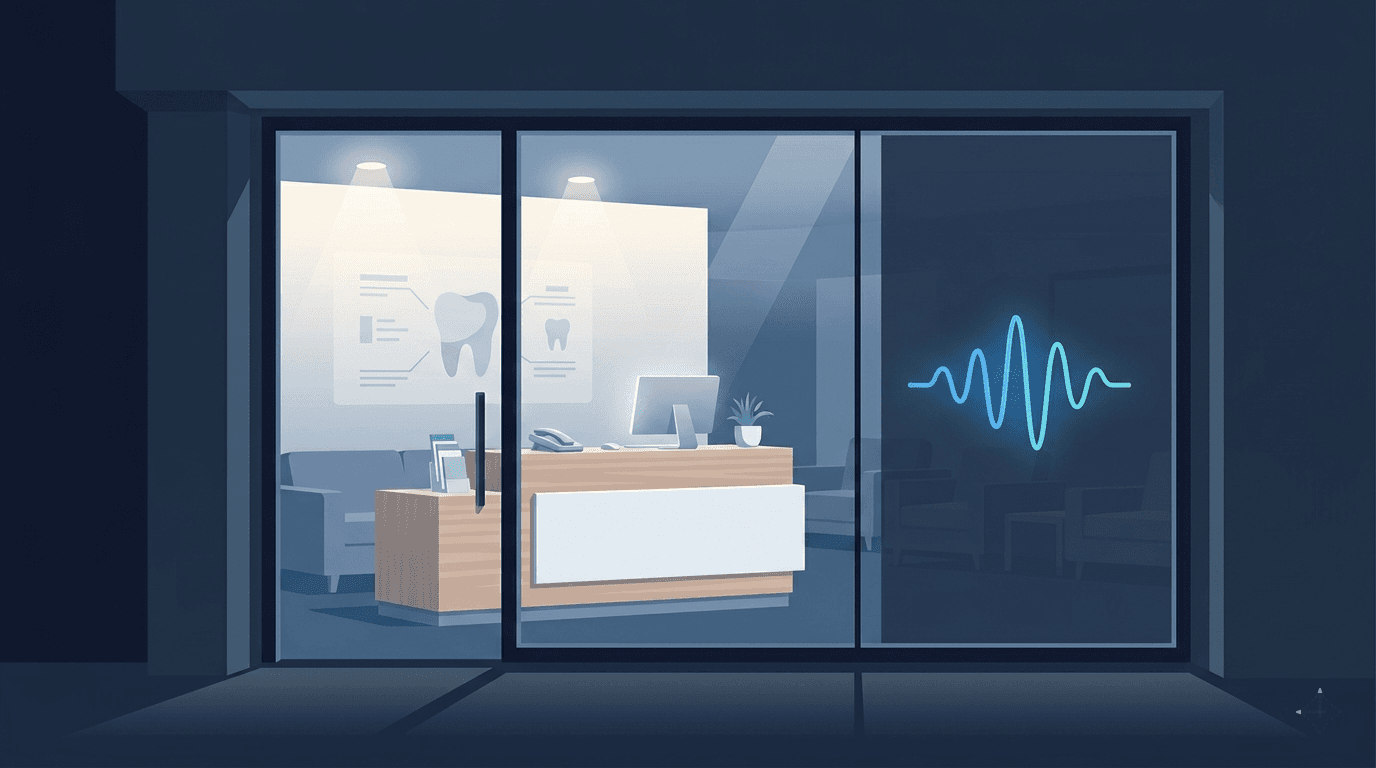
A parent calls your clinic at 6:30 PM on a Wednesday. Your office closed at 5:00. The AI answers. It identifies that the caller is inquiring about treatment for their child. It asks the child's age, the reason for the inquiry, and whether they have dental or orthodontic insurance. It checks your schedule for available new patient exam slots. It offers options. The parent selects one. The AI books the appointment into your PMS, captures the parent's contact information, and confirms the appointment via text.
Your team arrives the next morning and sees a new patient exam on the schedule with intake information already attached. No voicemail to listen to. No callback to make. No patient lost to a competitor who answered their phone.
That is the value proposition. Whether it works that smoothly depends entirely on the specific platform and how it was built.
Why Orthodontic Clinics Are Different
Most AI front desk platforms were built for general dentistry. This matters because orthodontic clinic operations differ from general dental operations in ways that directly affect how an AI phone system needs to function.
Scheduling complexity. An orthodontic clinic has more appointment types than a general dental clinic. New patient exams, records appointments, bonding appointments, adjustment appointments, emergency visits, debond appointments, and retainer checks all have different durations, clinical requirements, and provider preferences. An AI that treats all appointments as identical 30-minute slots will create scheduling problems.
Insurance verification complexity. Orthodontic insurance is structurally different from dental insurance. Orthodontic benefits typically include lifetime maximums rather than annual maximums, age limitations, waiting periods, and coordination of benefits between dental and orthodontic coverage. Verifying orthodontic insurance during a phone call requires the AI to understand these distinctions and query the appropriate benefit categories. For a deeper look at why this matters, see our post on orthodontic insurance verification.
Patient demographics. A significant percentage of orthodontic patients are minors. The person calling to schedule is typically a parent or guardian, not the patient. The AI needs to handle conversations where the caller is booking on behalf of someone else, collecting information about the patient while communicating with a different person.
Multi-stage patient journey. Orthodontic treatment involves a longer decision-making process than most dental procedures. The initial call is the beginning of a relationship that may span two to three years. The AI's first impression matters more because the stakes are higher and the relationship is longer.
PMS integration requirements. Orthodontic clinics run on Cloud 9, Dolphin, Ortho2, or Dentrix Ascend. Most AI platforms built their first integrations with Dentrix, Eaglesoft, and Open Dental, which are the dominant general dental PMS platforms. Whether the AI can book directly into your orthodontic PMS, or whether it just sends your team a notification, determines whether it saves work or creates work. We cover this topic in depth in our guide on AI and PMS integration for orthodontic clinics.
These differences are not minor. They determine whether an AI front desk tool that works well for a general dental clinic will work at all for an orthodontic clinic.
What AI Cannot Do
Honesty about limitations builds more credibility than overpromising. Here is what an AI front desk cannot do for your orthodontic clinic.
It cannot replace your treatment coordinator. The case acceptance conversation that happens after the exam, the financial presentation, the discussion about payment options, these require human judgment, empathy, and the ability to read a room. AI handles the top of the funnel. Humans close the case.
It cannot handle every call perfectly. AI systems have failure modes. Complex questions, unusual requests, emotional callers, and heavy accents can challenge current voice AI technology. A well-designed system has fallback protocols: transfer to a human, take a detailed message, or flag the call for priority follow-up. A poorly designed system hangs up or gives incorrect information.
It cannot fix a broken practice. If your conversion problem is in the exam room, not on the phone, an AI front desk will get more patients to the exam and your conversion rate will still be low. AI addresses Stage 1 of the patient funnel. It does not address Stage 4. If your conversion rate from exam to start is below 65%, you have a treatment presentation problem that AI cannot solve.
It cannot make your patients feel known. Long-term orthodontic patients who have been coming to your clinic for 18 months want to call and talk to someone who recognizes their name and knows their situation. AI can handle routine calls from these patients, like rescheduling, competently. But the personal relationship that orthodontic clinics are built on requires human interaction.
It is not a compliance shortcut. HIPAA compliance, BAA agreements, data security, and patient privacy are non-negotiable requirements for any system that handles patient information. An AI front desk must meet the same compliance standards as any other tool in your technology stack. If a vendor cannot provide a signed BAA, walk away.
When an AI Front Desk Makes Sense
Not every clinic needs an AI front desk. Here are the situations where the investment is most likely to produce a positive return.
You are missing calls. If your phone system data shows a miss rate above 15%, or if you do not have phone system data at all, an AI front desk addresses a quantifiable revenue leak. This is the simplest ROI calculation in the category: missed calls multiplied by the probability of new patient inquiry multiplied by average case value. For a detailed breakdown of what missed calls actually cost an orthodontic clinic, see our post on missed patient calls in orthodontics.
You have after-hours demand. If your clinic is in a market where parents research and call in the evening, you are losing patients to practices that answer. AI provides 24/7 coverage at a fraction of the cost of staffing a late shift.
Your front desk is overwhelmed. If your front desk team is juggling phones, check-ins, checkouts, insurance, and clinical coordination simultaneously, the phone will lose. AI handles overflow so your team can focus on the patients in the office.
You are growing and cannot hire fast enough. Staff shortages in orthodontics are real and persistent. The ADA reported that 62% of dentists identified staffing as their biggest challenge heading into 2025. AI does not solve the staffing problem, but it reduces the operational damage while you recruit.
You want data you do not currently have. AI systems log every call, every caller question, every booking, and every missed opportunity. Most clinics have never had visibility into their phone performance. This data alone can drive operational improvements beyond what the AI handles directly.
When an AI Front Desk Does Not Make Sense
You answer every call already. If your phone analytics show a miss rate below 5% and your team handles calls efficiently, the marginal value of AI is lower. You may still benefit from after-hours coverage, but the primary value proposition is weaker.
Your problem is downstream. If you are booking plenty of exams but not converting them to starts, the bottleneck is in the exam room, not on the phone. Solve the conversion problem first.
You are not ready to trust the technology. If you will second-guess every AI interaction and have your team re-call every patient the AI spoke with, you are doubling work instead of reducing it. The clinic owner needs to be comfortable with AI handling patient interactions, or the implementation will fail regardless of the technology's capability.
How to Evaluate the Category
If you decide an AI front desk is worth exploring, here is how to evaluate vendors without getting lost in marketing claims.
Call the AI yourself. Every reputable vendor will give you a phone number to test. Call it. Be a difficult caller. Change your mind mid-sentence. Ask about insurance. Ask a question the AI probably cannot answer. See how it handles each scenario.
Ask about your PMS. Specifically, ask whether the AI books appointments directly into your PMS or sends a notification. Ask for a demonstration on your exact platform. If they can only demonstrate on Dentrix, the orthodontic integration may not be ready.
Ask about orthodontic-specific features. Can the AI distinguish between appointment types? Does it understand orthodontic insurance verification? Has it been tested with orthodontic call scenarios, not just general dental?
Check the pricing model. Per-minute pricing can become expensive for clinics with high call volume. Flat monthly pricing provides cost predictability. Understand what is included and what costs extra.
Ask for references from orthodontic clinics. General dental testimonials do not validate orthodontic-specific functionality. Talk to orthodontic clinics that have used the platform for at least three months.
Orthia was built exclusively for orthodontic clinics. Book a demo.
The Staffing Context
The AI front desk category exists because of a structural problem in dental and orthodontic staffing that is not going away.
The ADA Health Policy Institute found that 62% of dentists identified staffing shortages as their biggest practice challenge heading into 2025. The AAO's Environmental and Technology Scan reported that over 50% of orthodontists cite staff turnover as a problem. The Levin Group's 2024 practice survey found that 74% of orthodontists believe there is a shortage of available staff, and only one in eight practices reported experiencing no staffing challenges.
Front desk positions are particularly vulnerable to turnover. The role has expanded dramatically over the past decade. What used to be a scheduling and greeting position now requires insurance knowledge, billing proficiency, financial conversation skills, and the ability to manage multiple software systems simultaneously. The complexity has increased while the pay has not kept pace with the demands.
AI does not solve this problem. But it changes the math. Instead of needing two front desk staff members to ensure phone coverage, you need one strong team member focused on in-office patient experience while the AI handles the phone. Your best employee spends their time on the work that requires human judgment and emotional intelligence, not racing to pick up a ringing phone.
The Honest Bottom Line
An AI front desk for an orthodontic clinic is not a magic solution. It is a specific tool that solves a specific problem: unanswered phone calls. If your clinic has that problem, the tool is worth serious consideration. If your clinic does not have that problem, your resources are better spent elsewhere.
The category is still young. The technology will improve. The integrations will deepen. The orthodontic-specific platforms will mature. But the core value proposition is already clear: answering the phone consistently is worth hundreds of thousands of dollars per year to an orthodontic clinic. Whether a human or an AI does the answering matters far less than whether it happens at all.
Frequently Asked Questions
An AI front desk is a voice AI system that answers inbound phone calls, handles patient conversations, captures new patient information, books appointments into your PMS, and verifies insurance eligibility. It provides 24/7 phone coverage without requiring additional staff.
Modern voice AI uses natural-sounding speech with appropriate pacing. Some callers notice. Many do not. Most patients care about whether their question was answered and their appointment was booked, not whether a human or AI did it.
Flat-rate pricing typically ranges from $200 to $600 per month for unlimited calls. Per-minute pricing ranges from $0.50 to $2.00 per minute. Compare to a full-time front desk employee at $35,000 to $50,000 per year plus benefits.
Some AI platforms offer direct or bridge-API integration with orthodontic PMS platforms. The depth varies significantly. Always request a live demonstration on your specific platform.
Any AI system handling patient health information must be HIPAA compliant with a signed Business Associate Agreement. Ask every vendor for their BAA, data security documentation, and compliance certifications.
OS
Olyver Sturdivant
Contributing writer at Orthia AI.