OS
Olyver SturdivantThe Real Cost of Missed Patient Calls in Orthodontics: Data, Math, and Solutions
Key Takeaways
- Dental clinics miss between 20% and 38% of incoming phone calls during business hours. After hours, the miss rate is effectively 100% unless a service is in place.
- Roughly 75% to 80% of callers who reach voicemail at a dental or orthodontic clinic do not leave a message and do not call back.
- At a $5,500 average orthodontic case value, a clinic missing just 5 new patient calls per month is losing approximately $330,000 per year in potential production.
- The orthodontic clinics losing the most revenue to missed calls are typically the busiest ones, because peak call volume coincides with peak in-office activity.
TL;DR: Orthodontic clinics miss 20-38% of calls during business hours and 100% after hours. 75-80% of callers who reach voicemail never call back. At $5,500 per case, missing just 5 new patient calls monthly costs ~$330,000/year. The busiest practices lose the most because peak call volume hits when front desk is busiest. AI phone answering solves this at $200-600/month versus $35K-50K/year for additional staff.
Missed calls are the single most expensive operational problem most orthodontic clinics do not know they have. Not because the problem is hidden. Because most clinics have never measured it.
The phone rings. Your team is chairside with a patient. The front desk is processing a checkout. The call goes to voicemail. The caller hangs up. They search "orthodontist near me" and call the next number on the list. That sequence happens in orthodontic clinics across the country every day, and each time it happens, it costs real money.
The Numbers
The data on missed calls in dental and orthodontic clinics comes from multiple sources, and the findings are remarkably consistent.
Weave Communications data shows approximately 35% of all calls to dental clinics go unanswered, either reaching voicemail or ringing out. During peak periods like lunch and patient checkout windows, the miss rate can exceed 50%. DentalBase reports that the average dental clinic misses 15% to 30% of incoming calls, with solo practices hitting the highest rates at around 32%. Specialty practices, including orthodontics, tend to perform slightly better at roughly 19%, likely because higher case values justify more front desk staffing.
But "slightly better" still means one in five calls is not answered. And the callers who do not get through behave in a predictable and costly way.
When a caller reaches voicemail at a dental clinic, roughly 75% to 80% never leave a message. They do not try again later. They call the next clinic. DenteMax reports that approximately 80% of missed calls in dental offices relate to appointment scheduling, meaning these are not solicitation calls or robocalls. They are patients trying to give you their business.
The Math for Orthodontic Clinics
The financial impact of missed calls is worse for orthodontic clinics than for general dental clinics, and the reason is straightforward: the average case value is higher.
A general dental clinic losing a new patient call loses roughly $850 in immediate revenue and a lifetime patient value of $8,000 to $25,000 depending on the source. An orthodontic clinic losing a new patient call loses $5,500 or more in immediate production from the case itself.
But orthodontic losses compound in ways that general dental losses do not.
Sibling cases. Orthodontic treatment often runs in families. A parent who books treatment for one child frequently returns with a second or third child. A missed call from a parent is not one lost case. It is potentially two or three lost cases over the following years.
Referral value. Satisfied orthodontic patients generate referrals. A parent who had a great experience tells other parents. The referral value of each patient extends well beyond the individual case revenue. A missed call breaks this chain before it starts.
Lifetime practice relationship. Many orthodontic patients return for retention visits, retainer replacements, and sometimes retreatment. The relationship spans years. The missed call does not just lose a $5,500 case. It loses the entire downstream value of that patient relationship.
Here is a conservative calculation. Assume your clinic receives 200 calls per month. Assume 20% are missed, which is the lower end of industry estimates. That is 40 missed calls. Assume 40% of those are from patients or prospective patients seeking care, not solicitors or existing patients with routine questions. That is 16 missed patient calls per month.
Assume half of those are new patient inquiries. That is 8 prospective new patients per month who called your clinic, did not reach anyone, and called a competitor instead. At $5,500 per case, that is $44,000 per month in lost potential production, or $528,000 per year. This is why understanding your patient conversion funnel matters so much — every stage of the funnel leaks, but the phone is where the largest and most preventable losses occur.
Even if you cut that estimate in half to account for callers who might not have converted anyway, the number is $264,000 per year. From a problem most clinic owners have never quantified.
Why the Busiest Practices Lose the Most
There is an uncomfortable irony in the missed call problem. The clinics that miss the most calls are often the ones with the healthiest patient demand. Their schedules are full. Their chairs are occupied. Their staff is busy. And that is precisely why the phone goes unanswered.
Peak call volume in most orthodontic clinics occurs during two windows: 8:00 to 10:00 AM and 2:00 to 4:00 PM. These are the same windows when the front desk is busiest with patient check-ins, checkouts, insurance questions, and clinical coordination. The staff member answering the phone is the same person checking in the patient standing at the counter.
When both happen simultaneously, the in-person patient wins. The phone caller loses. This is rational behavior by your staff. They are prioritizing the patient in front of them. But it creates a systematic leak in your new patient pipeline that compounds over months and years.
After-hours calls present an even more complete loss. Most orthodontic clinics close by 5:00 PM. Parents researching orthodontic treatment for their children often call in the evening, after work and after dinner. These calls go directly to voicemail. The parent may or may not call back the next day. If they do call back, they call during the same peak hours when the phone is least likely to be answered.
What Does Not Work
Orthodontic clinics have tried several approaches to the missed call problem. Most of them do not solve it.
Hiring additional front desk staff. This helps during business hours but does not address after-hours calls. It also does not solve the peak-hour problem fully because even two front desk staff members can be occupied simultaneously during busy periods. And front desk turnover in dentistry is high. The AAO's Environmental and Technology Scan reports that over 50% of orthodontists identify staff turnover as a problem impacting their practice. The 2025 Levin Group survey found 74% of respondents still believe there is a shortage of orthodontic staff available. Hiring your way out of the missed call problem is expensive, unreliable, and temporary.
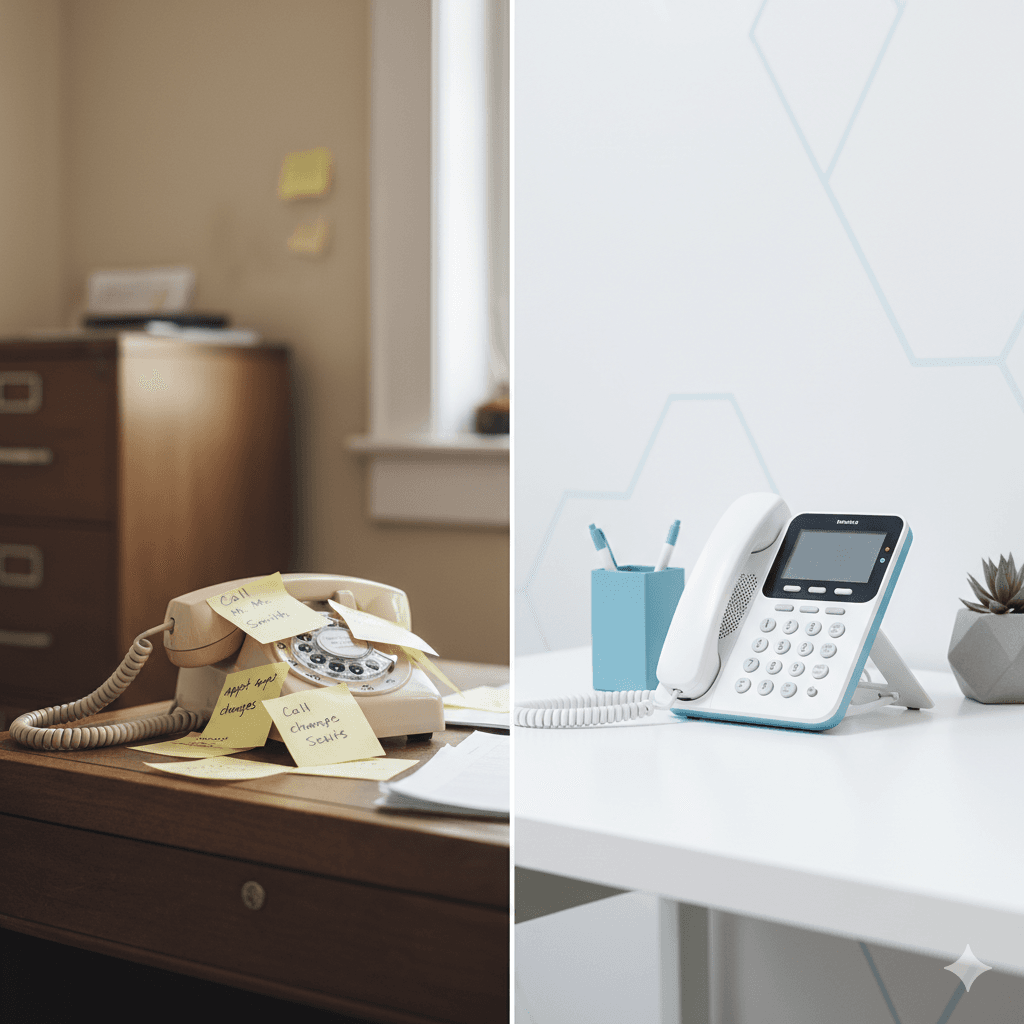
Traditional answering services. Offshore answering services are inexpensive but create a different problem. Language barriers, lack of orthodontic knowledge, and inability to access your schedule mean these services function as message-takers, not appointment-bookers. The caller's question is not answered. Their appointment is not booked. Your staff still has to call them back, if the caller left a message, which most do not. For a deeper comparison, see our breakdown of AI receptionists versus traditional answering services.
Voicemail with callback. This approach assumes the caller will leave a message and that your team will call back promptly. Both assumptions are wrong. Most callers do not leave messages, and callback during the next business day puts you 12 to 18 hours behind the moment of intent. The patient has already called two other practices and may have already scheduled.
Online scheduling as a substitute. Online scheduling is valuable as a complement to phone coverage but it is not a replacement. Industry data consistently shows that the majority of dental appointments are still booked by phone. Patients call when they have questions that online forms cannot answer: Does my insurance cover this? Can I bring both kids at the same time? What should I expect at the first appointment? A "book online" button does not answer these questions.
What Works
The clinics that have effectively solved the missed call problem share a common approach: they treat phone coverage as infrastructure rather than a staffing decision.
AI phone answering. AI front desk systems answer every call instantly, 24 hours a day, 7 days a week. Modern AI voice systems handle natural conversations, understand orthodontic terminology, ask appropriate intake questions, and book appointments directly into the practice management system. The AI does not put callers on hold. It does not take lunch breaks. It does not call in sick.
The caller's intent is captured in the moment it exists. If they are a new patient, the appointment is booked before they hang up. If they have a question the AI cannot answer, the call is transferred to the clinic or a detailed message is logged for staff follow-up.
Orthia is built specifically for orthodontic clinics and integrates directly with Cloud 9, Dolphin, Ortho2, and other orthodontic PMS platforms. It can also handle insurance verification during the call, answering one of the most common questions new patients have before they even walk in the door. See how it works.
Overflow routing during business hours. Even practices with strong front desk teams benefit from overflow routing. When the front desk is occupied and cannot answer within a set number of rings, the call automatically routes to an AI system or backup service. The caller never reaches voicemail. They never hear a busy signal. They get a live response every time.
After-hours coverage. This is the simplest and highest-impact change most clinics can make. If you do nothing else, ensure that every call after 5:00 PM is answered by a system that can provide information and book appointments. These are the calls your competitors are missing too. The clinic that answers wins the patient.
How to Measure Your Missed Call Rate
Before you can fix the problem, you need to know its size. Here is how to measure it.
Check your phone system. Most VoIP systems and modern phone systems provide call analytics. Look for total inbound calls, answered calls, calls to voicemail, and abandoned calls (caller hung up while ringing). If your phone system does not provide this data, that is your first investment.
Calculate your miss rate. Divide missed calls (voicemail plus abandoned) by total inbound calls. If the result is above 15%, you have a significant revenue leak. If it is above 25%, you have an urgent one.
Identify peak miss periods. Look at missed calls by hour of day. You will likely see spikes during the first hour of the day, around lunch, and during the 2:00 to 4:00 PM checkout rush. After-hours calls will show as 100% missed unless you have coverage in place.
Estimate revenue impact. Multiply your monthly missed calls by the percentage that are likely patient calls (use 40% as a conservative estimate). Multiply the patient calls by the percentage that are likely new patient inquiries (use 30% to 50%). Multiply by your average case value. The result is your estimated monthly revenue loss from missed calls.
Most orthodontists who run this calculation for the first time are surprised by the number. It is almost always larger than they expected.
The Competitive Advantage of Answering
In a market where most clinics miss 20% or more of their calls, simply answering every call creates a measurable competitive advantage. You are not competing against perfection. You are competing against voicemail.
The parent who calls three orthodontists on a Saturday morning will schedule with the one who answers. Not the one with the best Google reviews. Not the one with the newest office. The one who picked up the phone.
Phone coverage is not a technology decision. It is a patient acquisition decision. And at $5,500 per case, it is one of the highest-ROI decisions an orthodontic clinic can make.
Frequently Asked Questions
Specialty dental clinics including orthodontics miss approximately 19% to 30% of incoming calls during business hours. After hours, the miss rate is effectively 100% unless a service is in place.
At a $5,500 average case value, each missed new patient call represents a potential $5,500 or more in lost production. A clinic missing 5 new patient inquiries per month is potentially losing $330,000 per year.
Most do not. Industry data consistently shows that 75% to 80% of callers who reach voicemail hang up without leaving a message.
Modern AI voice systems handle natural conversations with appropriate pacing and tone. They can ask intake questions, check schedule availability, book appointments directly into the PMS, and verify insurance eligibility during the call.
The two are not mutually exclusive. Many clinics use AI for after-hours and overflow coverage while maintaining front desk staff for in-person interactions. AI costs $200 to $600 per month versus $35,000 to $50,000 per year for a full-time employee.
OS
Olyver Sturdivant
Contributing writer at Orthia AI.