OS
Olyver SturdivantOrthodontic Answering Service: AI vs. Traditional in 2026
Key Takeaways
- Traditional answering services cost $0.75 to $2.50 per minute or $1.39 to $2.75 per call for dental offices, adding up to $300 to $600+ per month for a typical orthodontic clinic
- Traditional services take messages but cannot book appointments into your PMS, creating a delay between the patient's call and the actual scheduling that loses a significant percentage of leads
- AI answering services operate on flat monthly pricing (typically $199 to $699/month) with no per-minute or per-call charges, making costs predictable regardless of call volume
- AI receptionists book appointments directly into Cloud 9, Dolphin, and Ortho2 in real time, eliminating the callback step that traditional services require
- Only 20 to 30% of callers leave a voicemail when they reach one, meaning voicemail-based overflow solutions lose the majority of after-hours leads
- Orthodontic calls require specialty knowledge that general answering service operators do not have: appointment types, treatment terminology, and insurance structures that differ from general dental
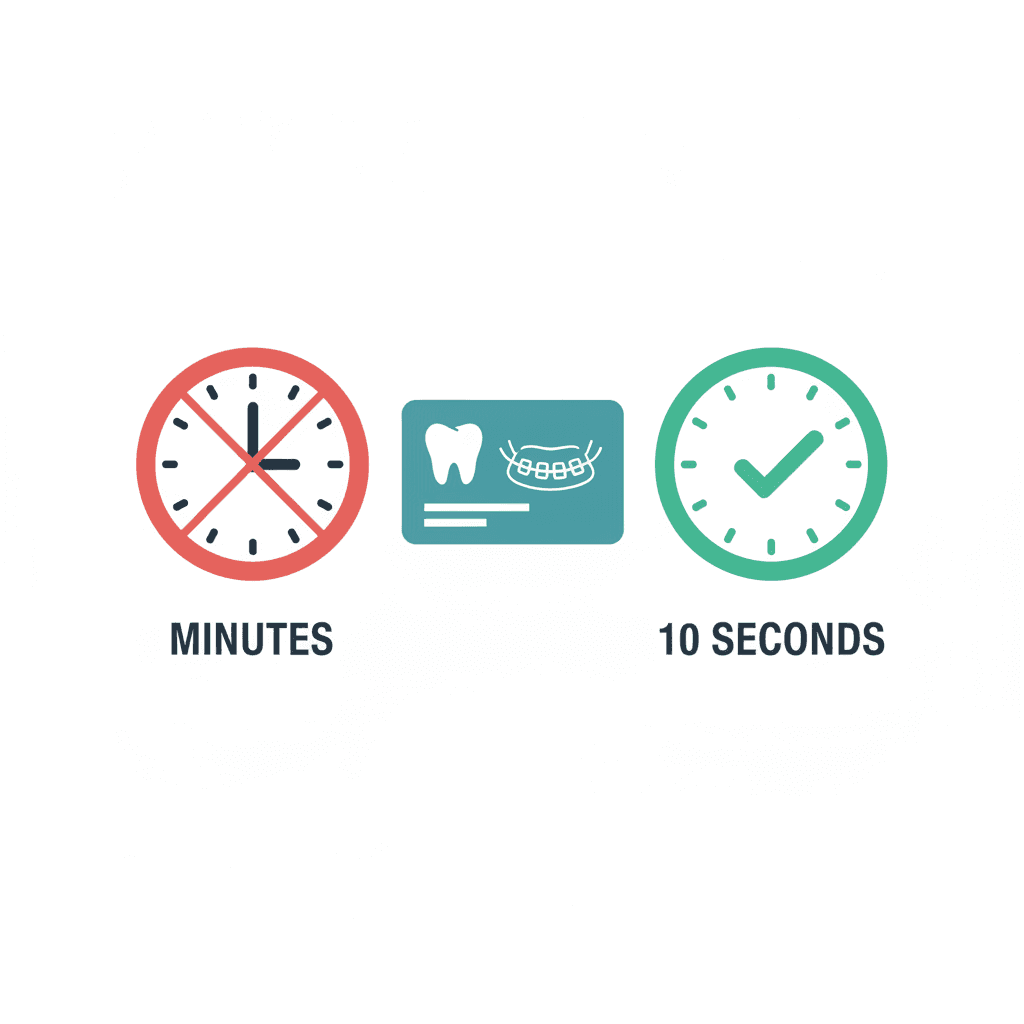
- Orthia answers 100% of calls 24/7, verifies insurance in under 10 seconds, and books directly into your orthodontic PMS, replacing both traditional answering services and after-hours voicemail
Your front desk staff is with a patient. The phone rings. It goes to voicemail, or it forwards to an answering service. Either way, a new patient who was ready to schedule a consultation just hit a wall.
This scenario plays out dozens of times per week in most orthodontic clinics. The real cost of a missed patient call in orthodontics is far higher than most owners realize. The question is not whether you need a solution for missed calls. The question is whether that solution actually converts callers into booked patients or just takes a message that someone has to follow up on tomorrow.
Traditional answering services and AI-powered answering services both claim to solve this problem. But they solve it in fundamentally different ways, at different price points, with dramatically different outcomes. Here is an honest comparison built specifically for orthodontic clinics.
What Traditional Answering Services Actually Do
A traditional answering service employs live human operators who answer your phone when your staff cannot. They follow a script, take a message, and deliver it to your office via email, text, or a web portal. Some offer appointment scheduling, but most are limited to basic message-taking and emergency call routing.
For orthodontic clinics, this means a caller reaches a live person instead of voicemail. That person says something like "Thank you for calling [Practice Name], how can I help you?" They write down the caller's name, phone number, and reason for calling. Then they send that message to your office.
Your office reviews the message the next morning (or the next business day if the call came in on a weekend). Someone on your team calls the patient back. If the patient answers, they schedule the appointment. If the patient does not answer, your team leaves a voicemail and tries again later.
The Pricing Structure
Traditional dental answering services typically charge in one of three ways.
Per-minute billing is the most common model. Rates range from $0.75 to $2.50 per minute depending on provider and plan tier. A dental answering service specifically costs about $1.35 to $1.43 per minute, with appointment scheduling pushing rates to $1.54 to $2.75 per call. For a clinic receiving 100 to 200 calls per month with an average call length of 3 minutes, this translates to $300 to $600+ monthly.
Per-call billing charges a flat fee per call regardless of duration. Rates range from $5 to $12 per call for premium providers. At 100 calls per month, that is $500 to $1,200 monthly.
Monthly packages bundle a set number of minutes (typically 100 to 500) for $150 to $1,200 per month, with overage charges for minutes beyond the cap. A dental office processing 400 minutes monthly might pay $325 on a 500-minute plan.
The Limitations for Orthodontic Clinics
Traditional answering services have several structural limitations that matter specifically for orthodontic clinics.
They cannot book appointments. The operator takes a message, but they do not have access to your Cloud 9, Dolphin, or Ortho2 calendar — and as a breakdown of what each PMS can and cannot do shows, even the platforms themselves have limited external integration. They cannot see provider availability, appointment type durations, or scheduling rules. The patient has to wait for a callback.
They do not understand orthodontic workflows. A general answering service operator does not know the difference between a records appointment and an adjustment. They cannot explain whether you offer clear aligners or what a consultation involves. They cannot answer questions about treatment duration or payment plans. They take a message.
They cannot verify insurance. When a caller asks "do you take my insurance?" the operator has no way to check — and orthodontic insurance verification takes far longer than dental due to lifetime maximums and age cutoffs. They take down the insurance information and pass it along. The actual verification happens hours or days later.
They create a callback loop. The operator takes the message. Your staff calls back. The patient does not answer. Your staff tries again. The patient calls back and gets voicemail because your staff is now with a patient. This loop can take 2 to 3 days to resolve. By then, many patients have called another clinic.
What AI Answering Services Actually Do
An AI answering service uses conversational AI to handle inbound calls. Instead of a human operator following a script, the AI engages in natural conversation, answers questions, checks schedule availability in real time, and books appointments directly into your practice management system.
For orthodontic clinics, this means a caller reaches an AI that sounds natural and responds intelligently. The AI can answer common questions about office hours, location, accepted insurance plans, and appointment types. It checks your PMS calendar in real time and offers available appointment slots. If the caller wants to schedule, the appointment is booked directly into your system before the call ends.
The Pricing Structure
AI answering services typically use flat monthly pricing. Most platforms charge $199 to $699 per month depending on features and call volume. There are no per-minute charges, no per-call charges, and no overage fees. Your cost is the same whether you receive 50 calls or 500 calls.
This pricing model is structurally different from traditional services. With a traditional service, your costs increase linearly with call volume. More calls equals a higher bill. With AI, your costs are fixed. More calls equals better value.
What Makes AI Different for Orthodontic Clinics
The core difference is not just cost. It is what happens during the call.
AI books the appointment during the call. There is no message to relay, no callback to make, no delay between the patient's intent and the scheduled appointment. The patient calls at 7 PM, the AI checks your Cloud 9 or Dolphin or Ortho2 calendar, finds an available consultation slot, and books it. The appointment is on your schedule before the patient hangs up.
AI answers orthodontic-specific questions. A well-configured AI receptionist can explain what a consultation involves, describe treatment options at a high level, provide information about accepted insurance plans, and answer questions about office location and hours. It handles the informational calls that currently consume front desk time.
AI verifies insurance in real time. Orthia runs both dental and orthodontic insurance eligibility and benefits verification in under 10 seconds during the call. When a patient asks "do you take my insurance?" the system can confirm coverage before the call ends.
AI handles multiple calls simultaneously. A traditional answering service can handle one call at a time per operator. If three patients call during the same 5-minute window, two go to hold or voicemail. AI has no such limitation. Every call is answered immediately, regardless of volume.
The Real Cost Comparison
Here is the math for a typical orthodontic clinic receiving 150 inbound calls per month.
Traditional Answering Service
At $1.40 per minute with an average call duration of 3 minutes: $630 per month. Add after-hours coverage surcharge: approximately $50 to $100. Total: $680 to $730 per month.
But this only covers message-taking. Your staff still has to call every patient back and book the appointment. That callback process takes an additional 5 to 10 minutes per patient in staff time. If 40% of those calls are new patient inquiries (60 calls), and each callback takes 7 minutes of staff time, that is 420 minutes or 7 hours of follow-up labor per month. At $25 per hour, that is another $175 in hidden labor costs.
True total cost: $855 to $905 per month.
AI Answering Service (Orthia)
Flat monthly fee with no per-minute or per-call charges. Appointments booked during the call, so no callback labor. Insurance verified during the call, so no separate verification step.
The labor savings compound over time. Your front desk staff spends zero time following up on after-hours messages because there are no messages. The appointment is already on the calendar.
The Revenue Difference
Cost comparison alone understates the gap. The real difference is in conversion.
A traditional answering service takes a message. Your staff calls back hours or days later. Industry data shows that responding to a lead within 5 minutes increases conversion by up to 9 times compared to waiting even 30 minutes. A next-day callback is not competitive.
An AI answering service books the appointment during the call. The conversion happens in real time. There is no lead decay, no callback loop, no competitor who answered faster.
If an AI system books even 3 additional new patient appointments per month compared to a traditional answering service (a conservative estimate given the callback delay problem), and each orthodontic case is worth $5,000 in treatment value, that is $15,000 per month in additional revenue potential.
Why Orthodontic Clinics Need Specialty-Specific Solutions
General dental answering services group orthodontics with general dentistry, periodontics, and oral surgery. They train operators on broad dental terminology and generic call scripts.
But orthodontic clinics have distinct operational needs that general solutions miss.
Appointment Type Complexity
An orthodontic office has appointment types that do not exist in general dental: initial consultations (60 to 90 minutes), records appointments (45 to 60 minutes), banding appointments, adjustment visits (15 to 30 minutes), debond appointments, retainer checks, and emergency bracket repair visits. Each type has different duration requirements and provider availability constraints.
A general answering service operator cannot differentiate between these. They take a message that says "patient wants to schedule." Your staff then has to determine what type of appointment, how long it should be, and which provider can see them.
An AI system configured for orthodontics understands these appointment types and schedules them correctly based on the rules you define.
Insurance Structure Differences
Orthodontic insurance works differently than dental insurance. Lifetime maximums instead of annual maximums. Installment payment structures. Age eligibility cutoffs. Pre-authorization requirements. A general answering service operator cannot explain any of this.
Orthia verifies orthodontic insurance eligibility and benefits in under 10 seconds, returning actual benefit data that your treatment coordinator can use to prepare financial presentations before the patient arrives.
Treatment Coordinator Workflow
In most orthodontic clinics, the treatment coordinator is the person who converts consultations into treatment starts. The TC needs verified insurance information and a complete patient intake before the consultation. Every hour of delay between the patient's first call and the consultation reduces conversion probability.
An AI system that books the appointment and verifies insurance during the initial call gives the TC more preparation time and better data. A traditional answering service that takes a message gives the TC a name and phone number.
How to Evaluate Your Options
If you are comparing answering services for your orthodontic clinic, here are the questions that matter.
Can the service book appointments directly into my PMS? If the answer is no, you are paying for message-taking, not appointment scheduling. Your staff will spend hours per week on callbacks.
Does the service understand orthodontic appointment types? If operators cannot differentiate between a records appointment and an adjustment, scheduling errors will create downstream problems.
Can the service verify insurance during the call? If not, you still need a separate verification workflow that adds hours of staff time per week.
What is the true total cost including staff follow-up time? A $300/month answering service that generates 7 hours of callback labor per month is really costing $475+. Compare that to the true cost of a solution that eliminates callbacks entirely.
What happens when call volume spikes? Per-minute services get more expensive as volume increases. Flat-rate services stay the same. If your marketing campaigns generate call spikes, per-minute pricing can blow up your budget.
Sources: Answering service pricing data from Ever-Help, NextPhone, Medical Call Service, and Find Answering Service industry reports; Arini dental call center vs AI comparison; dental answering service provider pages (Continental Message, Responsive Answering, Elation, Abby Connect, AnswerPro); lead response time data from industry conversion studies.
Frequently Asked Questions
Traditional answering services for orthodontic and dental clinics typically cost $300 to $600+ per month based on per-minute billing at $0.75 to $2.50 per minute or per-call billing at $1.39 to $2.75 per call. AI-powered answering services like Orthia use flat monthly pricing, typically $199 to $699 per month with no per-minute or per-call charges, regardless of call volume.
Traditional answering services cannot book appointments into Cloud 9, Dolphin, Ortho2, or other orthodontic clinic management systems. They take messages that your staff must follow up on. AI answering services like Orthia integrate directly with orthodontic PMS platforms and book appointments in real time during the patient's call, with no callback required.
A traditional answering service uses human operators who follow scripts to take messages and route calls. They cannot access your schedule, verify insurance, or book appointments. An AI receptionist like Orthia uses conversational AI to answer patient questions, check your PMS calendar in real time, verify insurance eligibility and benefits in under 10 seconds, and book appointments directly into your system during the call.
Yes. Orthodontic clinics have appointment types (records, banding, adjustments, debonds, retainer checks), insurance structures (lifetime maximums, installment payments, age cutoffs), and workflows (treatment coordinator-driven consultations) that general dental answering services do not handle correctly. A solution that understands orthodontic terminology and scheduling rules will produce significantly better results than a generic dental or medical answering service.
Industry data shows that only 20 to 30% of callers leave a voicemail when they reach one. The remaining 70 to 80% hang up and often call another clinic. For orthodontic clinics where each new patient case is worth $3,000 to $8,000 in treatment value, every unanswered after-hours call represents significant lost revenue.
Yes. Orthia is fully HIPAA compliant. All data is encrypted, stored on secure U.S. servers, and never shared with third parties. Every client receives a signed Business Associate Agreement during onboarding.
OS
Olyver Sturdivant
Contributing writer at Orthia AI.