OS
Olyver SturdivantHow Many New Patients Per Month Should an Orthodontic Clinic Get?
Key Takeaways
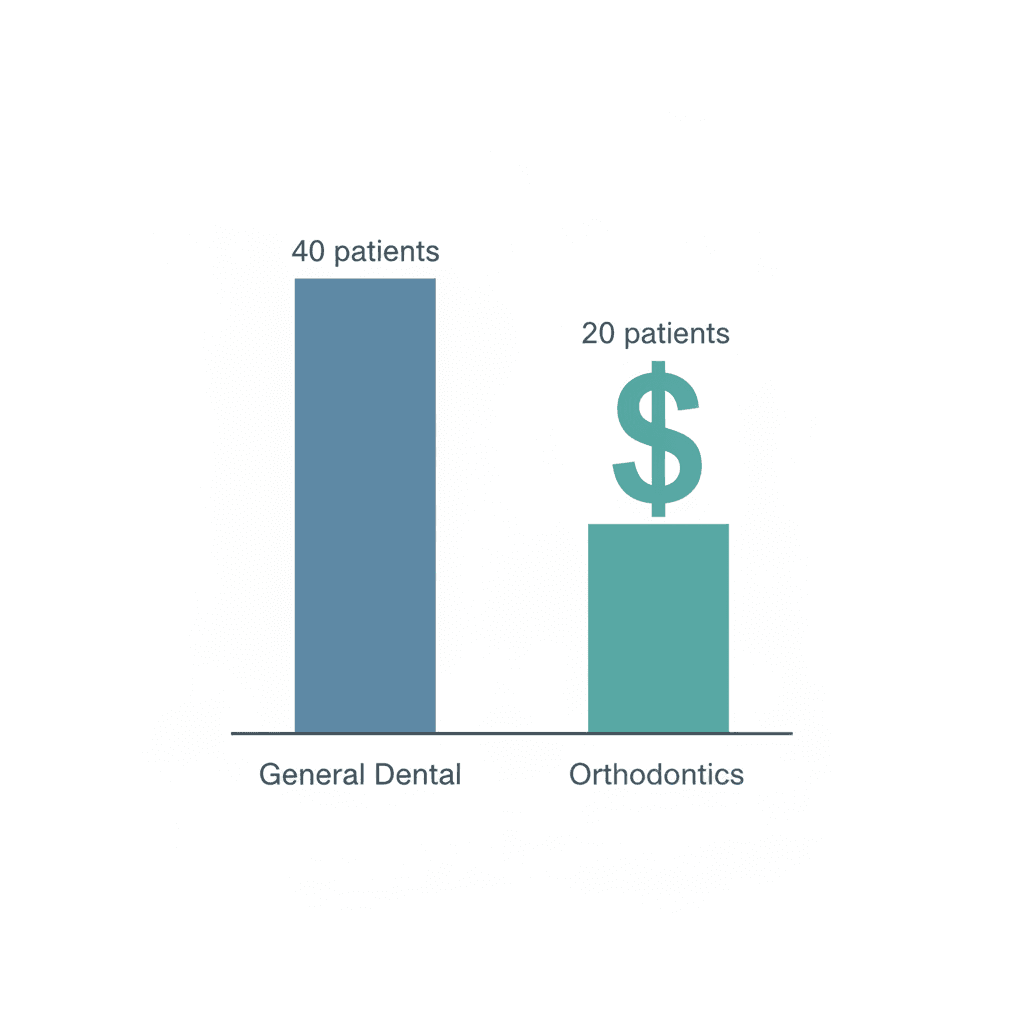
- A solo orthodontic clinic needs 15-30 new patient exams per month to sustain healthy growth, not 40-50 like general dental
- The AAO 2025 survey reports record patient counts at 696 active patients per member, the highest in the survey's 38-year history
- Planet DDS data from 1,500 orthodontic clinics shows nearly 50% see 100-399 new patient consults per month
- At $5,500 average case value, one additional start per month is worth $66,000 per year in production
- The real bottleneck is rarely lead volume — it is conversion rate, which averages 64-68% across the industry
- Practices spending $3,000-5,000/month on marketing typically generate 25-45 new patient inquiries once campaigns mature
Every orthodontic clinic owner asks this question at some point. Usually after a slow month, or after hearing another doctor brag about their numbers at a conference. The answer you will find on the internet is almost always wrong, because almost every article on this topic is written for general dentistry.
General dental clinics need 20 to 40 new patients per month. That number gets repeated so often that orthodontists internalize it as their target too. But the math in orthodontics is fundamentally different, and using dental benchmarks to measure orthodontic growth will either make you panic unnecessarily or give you false confidence.
An orthodontic case is worth $3,000 to $8,000. A general dental new patient is worth $850 in the first year. That single difference changes everything about how many new patients you actually need, what a healthy pipeline looks like, and where your real growth levers are.
The Short Answer: 15 to 30 New Patient Exams Per Month
For a solo orthodontist running a healthy, growing practice, 15 to 30 new patient exams per month is the typical range. That is not a universal rule. The right number depends on your capacity, fee structure, case mix, and conversion rate. But it is the range that most industry benchmarks and clinic consultants converge on for a single-doctor orthodontic clinic.
Here is why the number is so much lower than general dental.
A general dentist needs volume because individual patient value is lower. At $850 average first-year value, a general practice needs 25 or more new patients per month just to replace annual attrition (which runs 10-17% of the active patient base per year). Growth on top of that requires even more.
An orthodontist needs fewer patients because each case is worth four to ten times more. At a $5,500 average case value and a 65% conversion rate, 20 new patient exams per month produces 13 starts. That is $71,500 in monthly production from new patient starts alone, or $858,000 per year. A general dental clinic would need roughly 85 new patients per month to match that production.
The AAO's 2025 Economics of Orthodontics Survey, based on data from 635 respondents, reported the highest per-member patient count in the survey's 38-year history: 696 active patients per member in 2024, up from 574 in 2022. That is a 21% increase in two years. Starts and exam counts also hit record highs.
Planet DDS's 2025 Dental Industry Outlook, based on operational data from 1,500 orthodontic clinics, found that nearly 50% of clinics see 100 to 399 new patient consults per month, and less than 5% see more than 699 per month. For context, a clinic seeing 150 new consults per month is almost certainly a multi-doctor, multi-location operation.
The takeaway: if you are a solo practitioner doing 20 new patient exams per month with a solid conversion rate, you are in a healthy range. If you are below 15, you likely have a marketing or referral problem. If you are above 30, you should be evaluating whether you need a second doctor, additional chair time, or both.
Why the Number Alone Is Misleading
Counting new patient exams without context is like measuring a restaurant's success by how many people walk through the door. If half of them leave without ordering, you do not have a busy restaurant. You have a conversion problem.
The Levin Group and Orthodontic Products 2024 Practice Survey found that 64% of orthodontic clinics reported the same or higher new patient volume in 2024 compared to the prior year. Patient demand is not the problem for most clinics. The problem is what happens after the patient walks in.
Gaidge Analytics data shows the average orthodontic conversion rate is 68%. Planet DDS puts case acceptance at 64.4% across 1,500 practices. That means roughly one out of every three patients who comes in for an exam does not start treatment.
Here is where the math gets painful. At 20 new patient exams per month with a 65% conversion rate, you get 13 starts. At the same 20 exams with an 80% conversion rate, you get 16 starts. Those 3 extra starts per month, from the exact same lead volume, are worth $198,000 per year at a $5,500 average case value.
Most orthodontists who feel like they need more new patients actually need a better conversion rate — and as we detail in our analysis, your orthodontic conversion rate is probably wrong. That is a cheaper, faster problem to solve than generating more leads.
What Drives New Patient Volume in Orthodontics
The AAO survey and Levin Group data consistently show that orthodontic new patients come from a predictable set of sources. The mix has shifted over the past five years, but the fundamentals have not changed dramatically.
General dentist referrals still account for roughly 35-40% of new patients in the average practice. This percentage has been slowly declining for a decade as direct-to-consumer channels grow, but dentist referrals remain the single largest source for most clinics. The quality is high: referred patients show up at higher rates and convert at higher rates than any other source.
Internet search and website accounts for approximately 20-25% of new patients. This includes Google organic search, Google Ads, and patients who find the clinic through directories. This channel has grown steadily and is the primary reason orthodontic clinics invest in SEO and paid search.
Word of mouth and patient referrals contribute roughly 15-20%. Satisfied patients and their families remain one of the most reliable growth engines in orthodontics. The challenge is that this channel is hard to scale deliberately.
Social media accounts for 5-10%, though the 2022 Levin Group survey noted a decline in social media as a referral source, with some clinics pulling back on associated marketing spend. The clinics that succeed with social media tend to use it for brand awareness rather than direct patient acquisition.
Community involvement and events make up another 5-10%. The Levin Group data actually showed an increase in this channel recently, possibly as practices redirect marketing dollars from underperforming social media campaigns toward local visibility.
Orthodontic marketing agency data suggests that practices spending $3,000 to $5,000 per month on a mix of SEO and targeted advertising typically generate 25 to 45 new patient inquiries per month once campaigns mature, at a cost per acquisition that ranges from $300 to $500 per start.
The important nuance here is the difference between an inquiry and an exam. Not every person who calls or fills out a web form will schedule an appointment, and not every scheduled appointment will be kept. Industry data suggests that 30% or more of inbound calls to orthodontic clinics go unanswered during business hours. The revenue practices lose from those missed calls is substantial — if your phones are not being answered, your marketing is leaking money before the patient even gets into your pipeline.
How to Calculate Your Ideal New Patient Target
Rather than copying another clinic's numbers, calculate what your specific practice needs. The formula is straightforward.
Start with your annual production goal. Divide it by your average case value to get the number of starts you need per year. Divide that by 12 for monthly starts. Then divide by your conversion rate to get the number of new patient exams you need each month.
For example: a clinic targeting $1.8 million in annual production from new patient starts, with a $5,500 average case value, needs 327 starts per year, or about 27 per month. At a 70% conversion rate, that requires 39 new patient exams per month. At an 80% conversion rate, it requires 34.
Now factor in that not all production comes from new patient starts. Existing patients in active treatment generate a significant portion of revenue through adjustment visits, records, debonds, and retainer checks. Many clinics find that new patient starts account for 50-70% of total production, with the remainder coming from the active treatment base.
If new patient starts represent 60% of your production goal, the $1.8 million example becomes $1.08 million from new starts, which requires about 196 starts per year, or 16 per month. At a 70% conversion rate, that is 23 new patient exams per month. A much more realistic and achievable number for a solo practitioner.
This is why context matters. The clinic owner targeting 40 new patient exams per month may not need anywhere close to that number if their active patient base is already producing significant recurring revenue.
When You Actually Need More New Patients
There are specific situations where increasing new patient volume is the right move.
Your conversion rate is already above 75%. If you are converting well and still not hitting production targets, the constraint is genuinely lead volume. This is the one scenario where investing more in marketing makes sense as a first move.
You are adding capacity. A second doctor, additional chair time, a new location, or extended hours all create capacity that needs to be filled. In this case, lead generation should ramp up before the capacity comes online, not after.
Your referral base is eroding. If your general dentist referral volume is declining year over year and other channels are not making up the difference, you have a structural marketing problem. This trend has been documented across the industry as more practices invest in direct-to-consumer channels.
You are in a new or growing market. Practices in the first three to five years of operation or in markets with rapid population growth need higher new patient volume to build their active patient base.
In all other cases, the higher-leverage move is improving conversion and reducing leakage in your existing funnel before spending more on marketing. It is almost always cheaper and faster to convert the patients you already have walking through the door.
The Numbers That Matter More Than New Patient Count
Once you know your new patient volume is in a healthy range, shift your attention to the metrics that actually drive production and profit.
Starts per month. This is the number that directly drives revenue. Not exams, not calls, not website visitors. Starts. A clinic doing 25 exams with 80% conversion (20 starts) is outperforming a clinic doing 35 exams with 55% conversion (19 starts). Track starts, not leads.
Average case value. Small increases in fee create outsized production gains because they apply to every single case. A $200 fee increase across 200 annual starts is $40,000 in additional production with zero additional marketing cost.
Observation pool conversion. Gaidge benchmarks indicate that 20% of exams should go to observation, and 20% of your annual starts should come from observation patients converting to treatment. If your observation pool is a black hole where patients disappear, you are losing a major source of starts.
Pending patient follow-up rate. How many patients were recommended treatment but have not started? How many of those have been contacted in the last 30 days? Most clinics have a significant backlog of pending patients who said "maybe later." A systematic follow-up process converts a meaningful percentage of these patients without any new marketing spend.
Same-day start rate. Practices that offer same-day starts (or next-day starts) for patients who accept treatment dramatically reduce Stage 5 conversion loss. OrthoFi data shows conversion decays 20% the moment a patient walks out without scheduling. Every day of delay is money lost.
The Real Growth Formula for Orthodontic Clinics
Orthodontic clinic growth is not a single-variable problem. It is a system with four levers, and most owners only pull one of them.
Lever 1: Lead volume. More new patient inquiries. This is where most marketing dollars go. It works, but it is expensive and has diminishing returns.
Lever 2: Lead capture. The percentage of inquiries that actually reach your team and get scheduled. This is where phone answering, Orthia, online scheduling, and response speed live. It is the most underinvested lever in most clinics.
Lever 3: Conversion rate. The percentage of exams that become starts. This is where TC training, financial presentation, same-day starts, and follow-up systems live. A 10% conversion improvement often beats a 30% increase in marketing spend.
Lever 4: Case value. Higher fees, more comprehensive treatment plans, and better insurance utilization. This lever compounds because it applies to every patient.
The clinics growing the fastest in 2025 and 2026 are not the ones spending the most on marketing. They are the ones who have tightened all four levers so that every dollar spent on Lever 1 produces maximum return through Levers 2, 3, and 4.
If your clinic is getting 20 new patient exams per month and you feel like growth is stalling, do not automatically assume you need more leads. Run the numbers. You may need better phone coverage. You may need a tighter follow-up system. You may need a fee increase. Or you may genuinely need more marketing.
The data will tell you which lever to pull. Your gut will not.
Sources: AAO 2025 Economics of Orthodontics and Patient Census Survey, Planet DDS 2025 Dental Industry Outlook, Gaidge Analytics, Orthodontic Products/Levin Group 2024 Practice Survey, OrthoFi, CareCredit, Direction.com.
Frequently Asked Questions
Planet DDS data from 1,500 orthodontic clinics shows that nearly 50% see 100 to 399 new patient consults per month, though this includes multi-doctor and multi-location clinics. For a solo orthodontist, 15 to 30 new patient exams per month is the typical healthy range. The AAO 2025 survey reported record-high exam and start counts across the specialty in 2024.
This depends on your production goals, average case value, and conversion rate. A solo practice targeting $1.5 million in annual production with a $5,500 average case value needs about 273 starts per year, or 23 per month. At a 70% conversion rate, that requires approximately 33 new patient exams per month.
For most clinics, improving conversion is the higher-leverage move. Increasing conversion from 65% to 80% on 20 monthly exams produces 3 additional starts worth $198,000 per year. Generating those same 3 extra starts through marketing at $300 per lead would cost $5,400 per year in acquisition costs alone, plus require your team to handle 30% more exam volume.
Industry data shows $150 to $500 per new patient lead, depending on channel and market. Practices spending $3,000 to $5,000 per month on a mix of SEO and paid advertising typically generate 25 to 45 inquiries once campaigns mature. General dentist referrals remain the lowest-cost, highest-converting source for most orthodontic clinics.
AAO and Levin Group survey data shows: general dentist referrals (35-40%), internet search and website (20-25%), word of mouth and patient referrals (15-20%), social media (5-10%), and community events (5-10%). The mix has shifted toward digital channels over the past five years, but dentist referrals remain the single largest source.
Pull your numbers for the last 90 days. If your inquiry-to-scheduled rate is below 85%, you have a lead capture problem (likely phone handling or response time). If your exam-to-start conversion is below 70%, you have a conversion problem (likely financial presentation, TC skills, or follow-up). If both are above those thresholds and you are still short on production, then you have a lead volume problem and should invest in marketing.
OS
Olyver Sturdivant
Contributing writer at Orthia AI.