OS
Olyver SturdivantAI Front Desk for Florida Orthodontic DSOs: Orlando, Tampa, and Miami Deployments in 2026 (AAO Edition)
Key Takeaways
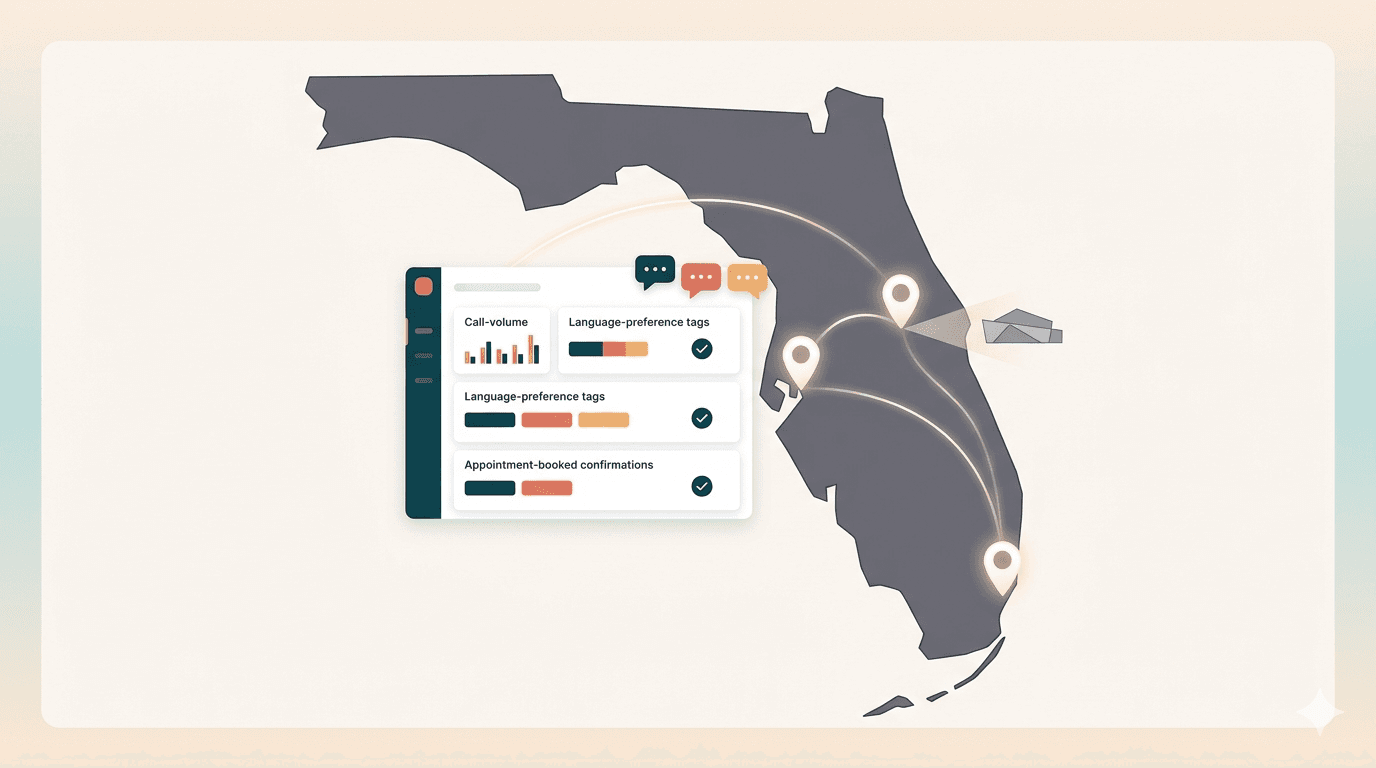
- Florida is one of the most concentrated orthodontic DSO markets in the country. Orlando, Tampa Bay, South Florida (Miami-Fort Lauderdale-West Palm), and Jacksonville each host multiple large multi-location groups operating 5+ locations on mixed Cloud 9 / Dolphin / Ortho2 environments.
- The AAO Annual Session 2026 is in Orlando, May 1-4, at the Orange County Convention Center. Florida orthodontic groups attending will see 15+ AI receptionist and AI front desk vendors actively pitching. Most will not have real orthodontic-specific PMS integration.
- Florida's patient population is the most linguistically diverse orthodontic market in the US — English, Spanish, Haitian Creole, and Portuguese are all common first languages depending on metro.
- The snowbird and part-year-resident dynamic creates orthodontic patient transfer complexity unique to Florida. Mid-treatment patients transferring in and out between November and April require specific workflows most PMS platforms handle poorly.
- Florida orthodontic DSOs running centralized call centers are paying $180K-$280K/year for coverage that typically still goes to voicemail overnight and rarely operates in Spanish or Creole. The AI front desk alternative runs roughly 15-20% of that cost with better coverage.
- For Florida clinics visiting the AAO 2026 exhibit floor, the most important vendor question is whether the tool writes directly into Cloud 9, Dolphin, or Ortho2 in real time during the call — not whether it integrates with Dentrix or Open Dental.
Florida orthodontics operates at a different scale and with a different patient mix than almost any other state market. The DSO footprint is dense, the patient population is multilingual, the seasonal resident dynamic creates scheduling complexity that does not exist in most states, and the AAO 2026 Annual Session in Orlando is about to put every major orthodontic AI vendor in front of the same audience of Florida clinic owners and DSO operators at once.
This post is for Florida orthodontic DSO operators, multi-location clinic owners, and anyone attending AAO 2026 looking for a framework to evaluate AI front desk vendors across 200+ exhibit booths.
No affiliate links. No vendor sponsorship. A practical breakdown of what actually matters for Florida orthodontic operations and how to separate real technology from marketing at a conference.
Why Florida Orthodontics Operates Differently
Four structural factors make Florida orthodontics operationally distinct:
DSO concentration. Florida has one of the densest concentrations of orthodontic DSOs and multi-location groups in the country, with significant private equity activity across Orlando, Tampa, and South Florida over the past decade. Many of the national orthodontic DSOs are either headquartered in Florida or have substantial Florida footprints.
Linguistic diversity. South Florida patient populations are heavily Spanish and Portuguese speaking, with significant Haitian Creole speaking communities in Miami-Dade and Broward. Tampa Bay has Spanish-dominant neighborhoods and growing Portuguese-speaking populations. Orlando has grown its Puerto Rican population substantially since 2017 and has one of the fastest-growing bilingual Spanish-English communities in the state.
Snowbird and part-year-resident patient flow. Florida receives a substantial seasonal influx of patients from the Northeast, Midwest, and Canada between November and April. Orthodontic patients mid-treatment when they arrive create a specific workflow — the clinic has to verify treatment history with the sending practice, continue appointments during the stay, and then hand off back to the original practice when the patient leaves.
Insurance mix. Florida clinics deal with Florida Blue (dominant in most markets), Delta Dental of Florida, Humana Florida plans, MetLife, Aetna, and AvMed. Medicaid orthodontic coverage is limited to medically necessary cases and varies by managed care plan. State-specific plan variants matter more than in states with a dominant single-carrier market.
Each of these has direct implications for what an AI front desk tool needs to handle in Florida.
The Three Major Florida Metros and Their Operational Realities
Orlando and Central Florida
Orlando is the fastest-growing orthodontic market in Florida and home to several of the state's largest multi-location orthodontic groups. The metro extends from Winter Garden and Windermere in the west through downtown Orlando to the Waterford Lakes / East Orlando corridor, and south through Lake Nona, Kissimmee, and St. Cloud into Osceola County. The Villages to the northwest adds a concentrated retiree-and-grandchildren demographic with specific scheduling patterns.
Orlando-specific operational patterns:
- Multi-location groups commonly in the 4-12 location range, clustered by quadrant: West Orlando (Winter Garden, Windermere, Dr. Phillips), North Orlando (Maitland, Winter Park, Altamonte Springs), East Orlando (Waterford Lakes, Avalon Park, Oviedo), and South Orlando (Lake Nona, Kissimmee, St. Cloud).
- Puerto Rican and broader Latino population growth post-2017 has made bilingual Spanish-English capability operationally critical in Kissimmee, Buenaventura Lakes, and parts of East Orlando.
- High volume of relocating families from the Northeast creates a steady mid-treatment transfer workflow year-round, spiking November through February.
- Tourism industry employment creates non-standard scheduling needs — parents working service industry shifts at the theme parks, hospitality jobs, and healthcare need appointment flexibility outside standard business hours.
- Cloud 9 has strong presence in the metro. Dolphin is present across established practices. Ortho2 Edge Cloud is growing among newer multi-location groups.
For an Orlando orthodontic DSO, the AI front desk deployment priorities are: bilingual Spanish-English capability, mid-treatment transfer workflow support, extended hour coverage to serve tourism-industry workers with non-standard schedules, and real-time Cloud 9 / Dolphin / Ortho2 integration across mixed portfolios.
Tampa Bay
The Tampa Bay metro includes Tampa, St. Petersburg, Clearwater, Brandon, and the expanding Pasco and Hernando county corridors. The market has a different character than Orlando — more established practices, slower but steadier population growth, and a DSO landscape weighted toward family-owned multi-location groups rather than heavily PE-backed platforms.
Tampa Bay operational patterns:
- Multi-location groups typically in the 3-8 location range, clustered around South Tampa / Hyde Park, Westchase / Citrus Park, Brandon / Riverview, St. Petersburg / Pinellas, and the Wesley Chapel / Lutz corridor.
- Spanish-bilingual demand is significant but not as dominant as South Florida. West Tampa, Town 'N' Country, and parts of Brandon have substantial bilingual populations.
- Retiree snowbird volume is highest in St. Petersburg and Pinellas County. This affects grandchild orthodontic scheduling more than direct patient volume — grandparents scheduling consults for visiting grandchildren.
- Established PMS footprint is heavier on Dolphin than Central or South Florida. Cloud 9 is growing. Ortho2 has modest presence.
For Tampa Bay orthodontic clinics, the AI front desk deployment priorities are: Dolphin integration depth (more critical than in Orlando or Miami), mid-treatment scheduling for part-year residents, Spanish-bilingual capability for the Hispanic community clusters, and handling of grandparent-initiated new patient calls (a distinct workflow where the insurance holder, guardian, and patient are three different people).
South Florida (Miami-Fort Lauderdale-West Palm Beach)
South Florida is the most linguistically and demographically complex orthodontic market in the US. The metro stretches from Homestead through Miami and Miami Beach through Broward County (Fort Lauderdale, Plantation, Pembroke Pines, Coral Springs) and into Palm Beach County (Boca Raton, Delray Beach, West Palm Beach, Jupiter). Each submarket has distinct patient demographics and language distributions.
South Florida operational patterns:
- Multi-location orthodontic groups typically in the 5-20+ location range, with some of the largest DSO operators in the country based in or operating heavily in the tri-county area.
- Miami-Dade is heavily Spanish-dominant with significant Portuguese-speaking (Brazilian) and Haitian Creole-speaking populations. English-only AI tools lose substantial call volume.
- Broward County is more English-Spanish bilingual with some Creole demand. Palm Beach is more English-Spanish with growing Portuguese.
- Insurance mix is complex. Florida Blue dominates, but high-income patient populations carry MetLife, Cigna, and Aetna commercial plans. Significant concierge-medicine-adjacent cash-pay share in parts of Miami Beach and Palm Beach.
- Snowbird and part-year-resident patient flow is highest in the country between Thanksgiving and Easter. Mid-treatment transfers inbound and outbound create sustained workflow load.
- PMS mix is the most varied in the state. Cloud 9, Dolphin, Ortho2, Dentrix Ascend, and Curve Hero all present in meaningful numbers across the tri-county region.
For South Florida orthodontic groups, the AI front desk deployment priorities are: true multilingual capability (Spanish + Portuguese + Haitian Creole), PMS flexibility across the most varied mix in Florida, mid-treatment transfer workflow, and high-volume concurrent call handling for the largest DSO footprints.
The AAO 2026 Vendor Landscape
The AAO Annual Session 2026 is in Orlando at the Orange County Convention Center, May 1-4. Florida orthodontic groups visiting the exhibit floor will see the highest concentration of AI receptionist and AI front desk vendors ever assembled at a single orthodontic conference.
A partial list of AI vendors likely to be pitching at AAO 2026 based on recent industry activity:
- Arini (dental AI receptionist, general dental focus with some ortho)
- TrueLark (acquired by Weave, dental AI, general dental focus)
- Weave (bundled phone + AI, general dental focus)
- Savvy Agents (multi-agent dental AI, 15+ PMS integrations, general dental focus)
- Emitrr (dental AI, general dental focus)
- Mango Voice (dental-focused phone system with some AI capabilities)
- Zaha AI (dental AI, emerging)
- HeyGent (dental AI, emerging)
- Annie / OrthoBerry / specialty-focused entrants
- Adit (broader dental platform with AI receptionist feature)
- Plus 5-10 smaller and newer entrants
Most of these were built primarily for general dental clinics. Orthodontic-specific integration with Cloud 9, Dolphin, and Ortho2 is typically absent or at Level 1 message-passing. The one-question diligence at any AAO booth: "Does the system write appointments directly into Cloud 9 / Dolphin / Ortho2 during the call, with correct appointment type and duration, and can I test it live with a real database right now?"
For a full breakdown of how the major AI receptionist platforms compare for orthodontic clinics specifically, see our dental AI receptionist competition analysis.
Orthia will be at AAO 2026, Booth 2277. We are the only AI front desk platform purpose-built exclusively for orthodontic clinics, with native Cloud 9, Dolphin, Ortho2, and Dentrix integration, and Spanish-language capability in native deployment.
Attending AAO 2026 in Orlando? Stop by Booth 2277 to test Orthia live with a real Cloud 9, Dolphin, or Ortho2 database — or book a demo in advance to schedule booth time.
The Multilingual Reality in Florida
No Florida orthodontic AI deployment decision can skip the language question. The realistic distribution across the state:
- Spanish-English bilingual capability is operationally required for any clinic operating in Miami-Dade, Broward, Osceola, Hillsborough's west side, and parts of Palm Beach County. For most Florida multi-location DSOs, this is not optional.
- Portuguese capability is operationally relevant for clinics in specific Miami-Dade and Broward submarkets with Brazilian populations (Deerfield Beach, Pompano, parts of Boca Raton).
- Haitian Creole capability is operationally relevant for clinics in North Miami, Miami Gardens, Little Haiti, and parts of Broward (Miramar, Pembroke Pines, North Lauderdale).
A generic English-only AI receptionist, or an AI with a Spanish IVR menu that cannot conduct a full conversation in Spanish, will filter out 30-50% of inbound call volume in the relevant submarkets. Patients hang up within 15 seconds of realizing they cannot be served in their primary language.
True multilingual capability means: the AI detects the caller's language preference from the first sentence, conducts the entire conversation in that language (including collecting demographics, answering orthodontic questions, verifying insurance, and confirming the appointment), and produces transcript documentation in both the original language and English for the clinic's records.
Orthia is deployed with this capability natively. Generic dental AI tools generally are not.
Snowbird and Mid-Treatment Transfer Workflow
A pattern unique to Florida: between November and April, a substantial share of orthodontic patient calls come from families who are part-year residents. Scenarios include:
- A 14-year-old mid-treatment with an orthodontist in Pennsylvania spending four months with grandparents in Naples. Needs continuation appointments, adjustments, and emergency coverage.
- A retired couple from New York buying a second home in Boca Raton whose adult daughter has moved to Florida with her teenage children mid-treatment.
- A family relocating permanently from Canada, with the teenager 14 months into a 22-month clear aligner treatment plan.
Each of these is a mid-treatment transfer workflow. The clinic has to:
- Verify treatment history from the sending orthodontist (often requiring records transfer).
- Verify insurance coverage, which may change with the relocation.
- Schedule an initial evaluation to confirm treatment progress and any necessary adjustments.
- Establish the cadence of ongoing appointments during the patient's stay in Florida.
- Handle the handoff back to the original practice at the end of the stay (or the full treatment plan transfer if the relocation is permanent).
Most practice management systems handle this workflow poorly. Most AI front desk tools cannot handle it at all — they route every inbound transfer call to the front desk as a manual task. Orthia's transfer workflow support captures the full context during the initial call and structures the follow-up tasks for the clinic's team to execute efficiently.
For a deeper look at the DSO-level operational patterns and multi-location ROI math, see our primary guide on AI front desk for orthodontic DSOs and multi-location clinics.
ROI Math for a Florida Orthodontic DSO
Consider a 7-location Florida orthodontic DSO with locations across Orlando and Tampa:
- 7 locations, averaging 140 inbound calls per location per month (980 calls/month total)
- 32% current miss rate (weighted average accounting for bilingual call hang-ups and after-hours)
- 2.2% new patient call rate — approximately 7 missed new patient calls/month across the group
- $6,200 average case value (Florida ortho case values typically skew higher than national)
- 68% consultation-to-start conversion
Annualized lost production: 7 missed new patient calls/month × 75% permanent loss × 68% conversion × $6,200 × 12 months = approximately $265,000/year in currently-lost production across the DSO.
Cost comparison for closing the gap across 7 locations:
| Solution | Annual Cost (7 locations) | 24/7 Coverage | Bilingual (Spanish/Portuguese/Creole) | Multi-PMS Support | Books Into PMS | |---|---|---|---|---|---| | Extended front desk staffing | $560K – $840K | No | Usually not | N/A | N/A | | Centralized call center | $200K – $320K | Limited | Often Spanish only | Rarely | Manual | | Traditional answering service | $34K – $100K | Yes | Sometimes | N/A | No | | Generic AI receptionist | $25K – $67K | Yes | Limited | Dentrix/Open Dental focused | Depends | | Orthodontic AI front desk (Orthia) | $42K – $58K | Yes | Yes, native | Cloud 9 / Dolphin / Ortho2 native | Yes, real-time |
The orthodontic-specific AI front desk solves every operational gap the Florida DSO faces at roughly 15-20% the cost of a centralized call center or extended staffing model. The centralized call center — still common among Florida DSO operators — is the most expensive option and solves the fewest problems relative to its cost.
What to Evaluate on the AAO 2026 Exhibit Floor
Walking the AAO 2026 exhibit floor with 15+ AI vendors pitching, the framework for cutting through marketing:
Qualifying question 1: Does the system write appointments directly into Cloud 9, Dolphin, or Ortho2 during the call? If the answer is qualified ("we integrate with all PMS systems..."), ask specifically which level of integration (reference the 5 levels of integration framework).
Qualifying question 2: Can I test it live right now with a real database? Any vendor not prepared to show a live test against a real PMS at the conference is not ready for production orthodontic deployment.
Qualifying question 3: What is the Spanish-language capability? Ask for a Spanish-language demo call from the booth. Most vendors will not be able to produce one on the spot.
Qualifying question 4: What is the pricing structure for a 5+ location deployment? Per-location pricing should land in the $400-$700/location/month range. Per-minute or per-call pricing for multi-location deployment is usually a red flag.
Qualifying question 5: Is the tool purpose-built for orthodontics or a general dental AI with orthodontic claims bolted on? Orthodontic-specific appointment type handling, orthodontic insurance verification including lifetime maximums and age-out provisions, and treatment phase logic for existing patients are all diagnostic. Ask how the AI handles a caller asking "I need to schedule a wire change for my daughter" — a general dental AI cannot handle this natively.
Orthia's Booth 2277 is set up specifically for this kind of live diligence. Bring your PMS credentials and we will run the test on your real data.
AAO 2026 attendees: book a dedicated 15-minute booth slot in advance so we can test Orthia against your actual Cloud 9, Dolphin, or Ortho2 database. Reserve your AAO slot.
State-Specific Insurance Verification for Florida
Florida orthodontic clinics deal with a specific insurance mix:
- Florida Blue (Blue Cross Blue Shield of Florida). Dominant share. Plan variants include HMO, PPO, BlueOptions, and BlueMedicare Rx dental riders.
- Delta Dental of Florida. Significant share, particularly in employer-sponsored plans.
- Humana Florida dental plans. Growing share, particularly in the Orlando and Tampa metros.
- MetLife. Strong share in corporate employee populations in South Florida.
- Aetna. Present across the state. Orthodontic benefit structure varies significantly by plan.
- Cigna. Growing share, particularly among private-pay-adjacent populations.
- AvMed. Regional Florida carrier with specific orthodontic benefit structures.
- Medicaid orthodontic coverage. Limited to medically necessary HLD index-qualifying cases. Managed care plan variants matter for verification.
A generic dental AI that verifies "Florida Blue" at the carrier level without distinguishing BlueOptions PPO from BlueCare HMO, or that cannot navigate the state-specific plan variants, is answering half the question. The Florida patient's most common follow-up — "what's my orthodontic lifetime maximum?" — is where the verification call either succeeds or loses the patient.
Orthia was built to handle state-specific plan variants for Florida natively, including full Florida Blue plan detail, Delta Dental of Florida orthodontic benefits, and real-time return of lifetime maximums, age-out provisions, and waiting periods during the call.
The Bottom Line for Florida Orthodontic Groups
Florida orthodontic DSOs and multi-location clinics operate at a scale and with an operational complexity that most general dental AI tools were not built to handle. The combination of dense DSO footprints, multilingual patient populations, seasonal resident patient flow, and complex state-specific insurance verification creates a set of requirements that purpose-built orthodontic AI front desk tools meet and generic dental AI tools do not.
AAO 2026 in Orlando will put most of the AI receptionist market in front of Florida clinic owners and DSO operators in a compressed timeframe. The evaluation framework above — focused on direct PMS write capability, multilingual depth, multi-PMS support, state-specific insurance handling, and live-testable performance — separates real technology from booth pitches quickly.
For Florida orthodontic groups planning 2026 operational investments, the front desk layer is now the single highest-ROI infrastructure decision. The ROI math, the multilingual requirement, the DSO-level consistency gains, and the 24/7 coverage compound into an advantage that the clinics capturing it are pulling away from the clinics that are not.
The Texas market has similar dynamics on some dimensions — for a comparison, see our guide on AI front desk for Texas orthodontic DSOs. The operational overlap across Texas and Florida is why purpose-built orthodontic AI tools win in both markets against generalized dental AI competitors.
About the author: Olyver Sturdivant is the founder of Orthia AI. Exhibiting at AAO 2026 in Orlando, Booth 2277. Building the future of orthodontic clinic automation.
Orthia answers every call 24/7, books into your PMS, and verifies insurance — so your team can focus on patients. Book a Demo · Visit Booth 2277 at AAO 2026 · Call Our AI
Frequently Asked Questions
Cloud 9 and Dolphin are the dominant systems across Florida DSOs of 4+ locations, with Ortho2 Edge Cloud growing fastest among newer multi-location groups. South Florida has the most varied PMS mix, including Dentrix Ascend and Curve Hero among some larger groups. Most Florida DSOs of 7+ locations operate a mixed PMS environment.
A well-designed AI front desk supports mid-treatment transfer workflows natively — collecting treatment history, verifying insurance changes on relocation, scheduling an initial evaluation, and handling the handoff back to the sending practice when the patient leaves. Orthia's transfer workflow captures the full context during the initial call.
True multilingual capability means the AI handles the entire call in the caller's preferred language — demographics, orthodontic questions, insurance verification, and booking. Orthia provides this natively in Spanish. Portuguese and Haitian Creole deployments are available on request for clinics where those languages are operationally critical.
Pricing typically runs $399-$699 per location per month depending on call volume tier, multi-language requirements, and PMS complexity. A 7-location Florida DSO typically lands in the $42K-$58K/year range for full AI front desk coverage — a fraction of the $200K-$320K/year cost of a centralized call center.
Orthia's insurance verification handles state-specific plan variants including Florida Blue BlueOptions, BlueCare HMO, and other Florida Blue product lines, plus Delta Dental of Florida orthodontic benefits with real-time return of lifetime maximums, age-out provisions, and waiting periods. Verification happens during the patient call in under 10 seconds.
Orthia is at AAO 2026 Booth 2277, May 1-4 at the Orange County Convention Center in Orlando. Live demo stations will run during all exhibit hall hours. 15-minute dedicated slots can be booked in advance at orthia.io/aao2026.
Yes. Orthia operates under a signed Business Associate Agreement (BAA) with every clinic, with HIPAA-standard encryption, access control, and audit logging. Florida does not impose state-level health privacy requirements beyond HIPAA for orthodontic clinics.
Miami orthodontic clinics need an AI front desk with true multilingual capability (Spanish, Portuguese, Haitian Creole), multi-PMS support across mixed Cloud 9 / Dolphin / Ortho2 environments, Florida Blue and Delta Dental of Florida insurance verification, and snowbird mid-treatment transfer workflows. Orthia is purpose-built for this exact combination.
OS
Olyver Sturdivant
Contributing writer at Orthia AI.
Related Articles
AI Front Desk for Orthodontic DSOs and Multi-Location Practices in 2026
Read more
Industry Insights
Dental AI Receptionist Competition: Every Platform Compared for 2026
Read more
AI Automation
AI Receptionist with PMS Integration: What Real Integration Looks Like vs. What Vendors Claim
Read more

Industry Insights
Cloud 9 vs Dolphin vs Ortho2: What Your Orthodontic PMS Can and Cannot Do in 2026
Read more
Industry Insights
After-Hours Orthodontic Calls: The 5 PM to 9 AM Revenue Gap That Practice Owners Keep Underestimating
Read more
Industry Insights
AI Front Desk for Texas Orthodontic DSOs: What DFW, Houston, Austin, and San Antonio Groups Are Deploying in 2026
Read more