OS
Olyver SturdivantAfter-Hours Orthodontic Calls: The 5 PM to 9 AM Revenue Gap That Practice Owners Keep Underestimating
Key Takeaways
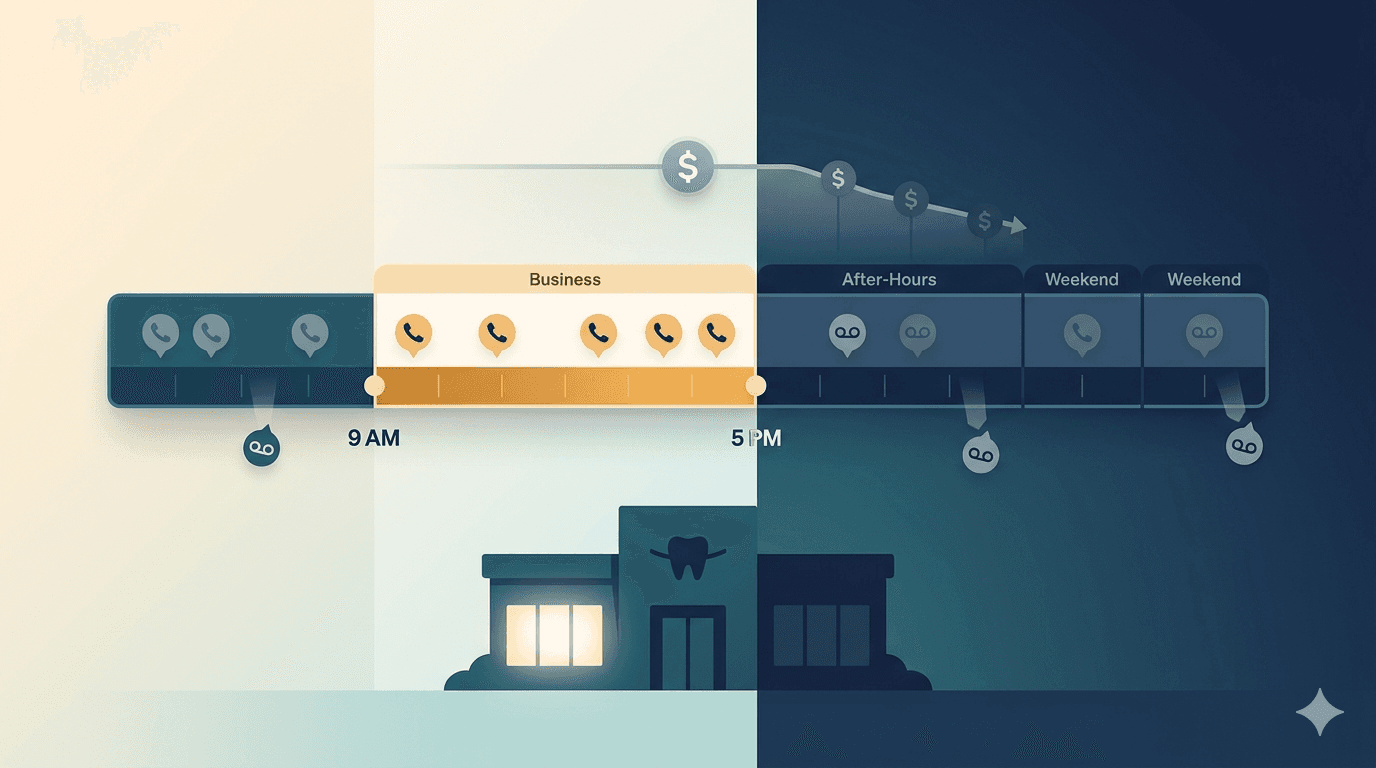
- For a typical orthodontic clinic, roughly 40-50% of new patient calls come outside business hours — evenings, weekends, and before 9 AM. Most are going to voicemail.
- Evening callers (5 PM to 9 PM) are disproportionately parents researching orthodontic treatment for a child. They convert at a higher rate than daytime callers because they are actively making a decision, not just collecting information.
- 75% of patients who reach voicemail never call back. For after-hours calls, the drop-off is worse — parents move down their list of three to five practices in a single evening.
- A single-location orthodontic clinic missing 30% of after-hours calls at 2% new-patient-call conversion and $5,500 average case value loses $15,000 to $30,000/month in potential production.
- Monday mornings compound the problem. Monday call volume runs approximately 40% higher than an average weekday because the weekend's missed calls all come back at once.
- The fix is not staffing. A human front desk extended to cover evenings and weekends costs $80,000 to $120,000/year. An AI front desk that covers the same gap runs $4,800 to $8,400/year.
Most orthodontic clinic owners underestimate the after-hours gap by a factor of three. When you ask them, "what percentage of your calls come outside business hours?", the typical answer is 15 to 20%. When you pull the actual data from a VoIP system or a call-tracking report, the number is almost always 40% or higher.
This post breaks down where the gap actually sits, why evening and weekend calls convert at a higher rate than most clinics assume, and what it costs to keep missing them.
No generalities. Real numbers from orthodontic-specific call data, benchmarked against AAO and Planet DDS survey results.
When Orthodontic Patients Actually Call
The assumption baked into most orthodontic clinic workflows is that patients call during business hours because that is when the office is open. This is a survivor bias. Clinic owners see the calls that come in while the phone is being answered and assume those represent the full demand curve. They do not.
Patients do not call during business hours because that is when they need orthodontic care. They call during business hours because they have been trained by decades of voicemail to give up outside of those hours. The underlying demand for orthodontic information and scheduling is spread throughout a 16-hour waking day.
The actual call-volume curve for orthodontic clinics that have 24/7 coverage looks like this:
- 7 AM to 9 AM (pre-business hours). 8-12% of inbound call volume. Parents calling before work to schedule consultations. Patients calling about bracket emergencies that happened overnight.
- 9 AM to 12 PM (morning block). 28-34% of call volume. Highest density of the day. Heavily weighted toward existing-patient administrative calls.
- 12 PM to 1 PM (lunch). 6-9% of call volume. Working parents call from lunch breaks. This slot has the highest miss rate in most clinics because the front desk is also on lunch.
- 1 PM to 5 PM (afternoon block). 22-28% of call volume. Second-highest block. Mixed new patient and administrative.
- 5 PM to 9 PM (evening block). 18-24% of call volume. Highest conversion density — parents actively shopping for orthodontic providers after the workday.
- 9 PM to 7 AM (overnight). 3-5% of call volume. Low density but high-value emergency calls (loose brackets, popped wires, pain after a same-day appliance).
- Weekends. 12-18% of weekly call volume. Saturday afternoons are the peak. Sundays are quieter but still non-trivial.
Add those up and the after-hours share — before 9 AM, after 5 PM, and weekends — lands between 40% and 52% of total inbound call volume. For clinics in affluent suburbs with working professional parents, the number skews higher.
Why Evening and Weekend Callers Convert Higher
There is a common assumption that after-hours callers are less serious — that "real" patients call during the day. The data does not support this. For orthodontic clinics with 24/7 call coverage, after-hours new patient inquiries convert at equivalent or higher rates than daytime inquiries.
The reason is simple. A daytime caller is often someone who happens to have five free minutes at work and is doing research while waiting on hold with another clinic. An evening caller — specifically the 5 PM to 9 PM window — is a parent who has just finished dinner, is sitting at the kitchen table, and has decided tonight is the night they are going to solve this. They are further down the decision funnel.
Weekend callers follow the same pattern. A Saturday morning caller has blocked time specifically to deal with household administration. Orthodontic consultations are on the list alongside pediatrician appointments, soccer registration, and the car service. Intent is high.
For a deeper look at the full orthodontic conversion funnel and where in the funnel response speed actually matters, see our breakdown of orthodontic new patient conversion rates.
The Math on After-Hours Missed Revenue
Here is a typical single-location orthodontic clinic:
- 800 total inbound calls per month
- 45% of calls occur after hours (360 calls/month)
- 2% of total calls are new patient inquiries (roughly 16 new patient calls/month, with about 7 of those after hours)
- $5,500 average case value
- 68% consultation-to-start conversion rate (industry average per Gaidge Analytics)
If the clinic captures 100% of its 7 after-hours new patient inquiries per month at 68% conversion, that is 4.76 additional starts per month. At $5,500, that is approximately $26,180 in additional monthly production, or roughly $314,000 annualized.
If the clinic loses all 7 to voicemail, 75% never call back. That is 5.25 inquiries permanently lost per month. Of the 1.75 who do call back, some percentage have already booked with a competitor. Realistic recapture in the wake of a voicemail is 10-15% of the original inquiry volume — roughly 1 to 1.5 recovered calls out of 7.
The gap between "captures all after-hours calls" and "loses all after-hours calls to voicemail" is roughly $250,000 to $310,000 per year in a single-location practice.
For clinics with higher marketing spend — the ones generating 25-45 new patient inquiries per month — the after-hours share scales proportionally. A clinic running strong Google Ads campaigns or referral programs is generating more inquiries across all hours, including the after-hours block. If they are only capturing the business-hours portion, they are effectively paying full price for leads and collecting half of them.
For the full methodology on calculating your own missed-call revenue impact, see our breakdown of the real cost of a missed patient call in orthodontics.
The Monday Morning Problem
Monday mornings compound this. Weekend call volume is roughly 12-18% of the weekly total, but those calls do not disappear when they hit voicemail. They come back. Monday morning call volume runs approximately 40% higher than an average weekday as the weekend backlog flows in.
This creates a predictable front desk crisis every week. Your team walks in at 8:30 or 9 AM to a voicemail queue, an email queue, and a live phone already ringing. They spend the first two hours catching up on weekend messages while new Monday calls are also landing. Some of those new Monday calls end up in voicemail because the team is processing Friday-evening and Saturday messages. Those Monday-morning voicemails then compound the backlog.
The clinics that have eliminated this weekly crisis have not done it by hiring more Monday-morning staff. They have done it by closing the loop on weekend calls when they happen — Saturday at 2 PM or Sunday at 11 AM — so nothing is in the queue Monday morning.
See how Orthia captures after-hours calls and books them into Cloud 9, Dolphin, or Ortho2 in real time. Book a demo and test it with weekend or evening scenarios.
What Does Not Work for After-Hours Coverage
Clinic owners have tried several approaches to close the after-hours gap. Most have downsides that outweigh the fix.
Extending front desk hours. A staff member covering 8 AM to 7 PM costs a full-time salary plus benefits. Two staggered part-timers to cover 7 AM to 9 PM runs $80,000 to $120,000/year for a single location and creates scheduling complexity. Weekend coverage adds more. This works but is expensive and does not solve the 9 PM to 7 AM gap or genuine holiday coverage.
Routing to the clinic owner's cell phone. A common stopgap for after-hours coverage. Orthodontists who do this almost universally stop within 90 days. The call volume is higher than expected, the calls are mostly routine, and owners burn out fast.
Traditional orthodontic answering services. Cover the time window but cannot book appointments, cannot verify orthodontic insurance, and deliver messages that your front desk has to process Monday morning — which reintroduces the Monday backlog problem in a slightly smaller form. For a full breakdown, see our comparison of orthodontic answering services and AI receptionists.
Voicemail with a "callback within 24 hours" promise. The most common approach, and the most expensive one. Voicemail captures roughly 25% of callers; 75% do not leave a message and do not call back. Even within the 25% who leave messages, the 20-hour decay window between voicemail and callback is where most of the conversion drop occurs.
Online scheduling widgets. Useful for a fraction of callers who prefer self-service, but most orthodontic new patient inquiries still come by phone because parents have questions — about insurance, treatment options, age, pricing — that they want answered before committing. A scheduling widget does not answer the question. It books around the question.
What Actually Closes the Gap
The only approach that solves the after-hours gap economically is an AI front desk tool that handles calls with the same capability as a daytime staff member. Specifically:
- Answers within two rings, 24/7. No hold queue, no voicemail, no "we're closed, please call back."
- Books directly into Cloud 9, Dolphin, or Ortho2. Appointment is confirmed during the call. Nothing in the Monday morning queue.
- Verifies orthodontic insurance during the call. Delta Dental, MetLife, Cigna, Aetna, and state-specific carriers. Lifetime maximums, age-out provisions, works-in-progress clauses.
- Handles orthodontic-specific questions. Treatment phase logic for existing patients in active treatment. Emergency triage for bracket breaks and loose wires. Fee and financing questions using your clinic's actual pricing.
- Escalates appropriately. Clinical questions that require an orthodontist, complex treatment plan changes, or unusual billing situations get captured as a high-priority task for your team to handle at the start of the next business day.
At $399 to $699/month, the AI front desk cost to cover the full 24/7 window is 5-7% of the equivalent human staffing cost. The conversion math works out heavily in favor of the AI tool even before the labor savings.
For a deeper technical breakdown of what "real" PMS integration looks like and how to evaluate whether an AI tool actually closes the loop, see our guide on AI receptionist PMS integration levels.
Orthodontic Specificity Matters More After Hours
An evening caller asking "does my insurance cover orthodontic treatment for my 14-year-old?" is not a question a generic dental AI receptionist can answer well. Orthodontic coverage has age-out provisions (typically 19), lifetime maximums (typically $1,000-2,500), treatment-in-progress clauses, and 24-month benefit period clauses that do not exist in general dental coverage. A generic AI returning "your Delta Dental plan is active" without the orthodontic-specific details is answering half the question. The parent hangs up and calls the next clinic.
Similarly, emergency triage is orthodontic-specific. A loose bracket at 10 PM is not a true clinical emergency — it is a situation that can wait until morning with some patient reassurance and a next-day appointment. A broken wire poking into a cheek does require after-hours intervention in some cases. A generic AI front desk without orthodontic triage protocols will either escalate everything (burning out the on-call orthodontist) or escalate nothing (missing real emergencies).
Orthia was built to handle both of these cases natively. Orthodontic insurance verification with full benefit detail. Emergency triage protocols specific to orthodontic appliances. Treatment phase logic that recognizes a caller in month 14 of clear aligner treatment needs a different workflow than a new patient.
The Simplest Way to Measure Your Own Gap
You do not need to invest in new tools to measure your after-hours gap. If you run a VoIP phone system, the data is in your call log. Steps:
- Pull 30 days of call-log data. Every inbound call, with timestamp, duration, and answered/missed status.
- Segment by time. Group into buckets: before 9 AM, 9 AM-5 PM, 5 PM-9 PM, 9 PM-7 AM, and weekends.
- Calculate after-hours share. Sum the non-business-hours buckets and divide by total.
- Calculate miss rate by segment. What percentage of each bucket went to voicemail.
- Apply new patient call rate. Industry average is 2% of inbound calls are new patient inquiries. Your rate may be higher or lower.
- Apply case value and conversion rate. $5,500 average case value, 68% conversion (or your actual numbers if you have them).
The output is an estimate of monthly revenue currently flowing to competitors through your after-hours voicemail. For most single-location orthodontic clinics, the number lands between $15,000 and $35,000/month. For multi-location clinics and DSOs, the number scales linearly.
Stop sending your after-hours calls to voicemail. Book an Orthia demo and watch a live weekend or evening call get booked directly into Cloud 9, Dolphin, or Ortho2.
The Bottom Line
After-hours coverage is not a premium feature or a nice-to-have for orthodontic clinics. It is where a substantial portion of new patient demand actually lives. Clinic owners who run the numbers on their own call data almost always find the gap is two to three times larger than they assumed.
The traditional solutions — extended staffing, call forwarding, answering services, voicemail — each solve a sliver of the problem at disproportionate cost. An AI front desk purpose-built for orthodontics closes the full gap at a fraction of the cost of the alternatives, and it does so without requiring any change to your PMS, your staff, or your workflow.
At $5,500 per case and 68% conversion, the math is not ambiguous. The clinics capturing their after-hours demand are compounding a roughly 30% monthly production advantage over practices that send those calls to voicemail. Over 12 months, that gap becomes the difference between a clinic that hits its growth targets and one that doesn't.
About the author: Olyver Sturdivant is the founder of Orthia AI. Building the future of orthodontic clinic automation.
Orthia answers every call 24/7, books into your PMS, and verifies insurance — so your team can focus on patients. Book a Demo · Call Our AI
Frequently Asked Questions
For a typical orthodontic clinic, 40-52% of inbound calls occur outside 9 AM to 5 PM business hours. This includes the pre-business-hours window (7-9 AM), the lunch hour (12-1 PM, which is after-hours for most front desks), the evening window (5-9 PM), the overnight window (9 PM-7 AM), and the full weekend. Affluent suburban practices with working professional parents often skew even higher on evening and weekend volume.
Yes, and often at higher rates than daytime callers. Evening callers (5-9 PM) are typically parents who have set aside specific time to research orthodontic treatment for a child. They are further along in the decision process than a typical daytime caller. Weekend callers show similar patterns — blocked time dedicated to household decisions.
Pull your VoIP call log for the last 30 days. Any modern phone system (RingCentral, Weave, Spruce, 8x8, Mango Voice) provides this data. Count the calls received outside 9 AM to 5 PM Monday through Friday. Count the share that went to voicemail or were unanswered. If you are not capturing those, you are missing them — roughly 75% of voicemail callers never follow up.
An answering service prevents voicemail but does not close the booking loop. The patient gets told someone will call you back tomorrow, which from the patient's perspective is functionally a delayed voicemail. The conversion drop happens during the 12-20 hour gap between when the patient is ready to book and when someone from your clinic calls them back.
A properly configured AI front desk has orthodontic-specific triage protocols. Routine bracket looseness with no pain gets reassurance and a next-morning appointment. A wire poking into cheek tissue or a patient with a same-day appliance experiencing significant pain gets routed to the on-call orthodontist with full context.
Most orthodontic clinics spending $3,000-5,000/month on marketing are driving inquiries across all hours — not only during business hours. If you are capturing only the business-hours portion of paid lead flow, you are effectively paying full CPC or CPM rates and collecting roughly half of the resulting patients. Adding 24/7 coverage effectively doubles the return on existing marketing spend without increasing the budget.
A typical single-location orthodontic clinic missing after-hours calls loses $15,000 to $35,000 per month in potential production. At $5,500 average case value and 68% conversion, even 5-7 missed new patient calls per month compounds to $250,000-$310,000 per year in lost revenue flowing to competitors.
OS
Olyver Sturdivant
Contributing writer at Orthia AI.
Related Articles
Practice Growth
The Real Cost of a Missed Patient Call in Orthodontics
Read more
Practice Growth
Your Orthodontic New Patient Conversion Rate Is Probably Wrong
Read more
Practice Growth
How Many New Patients Per Month Should an Orthodontic Clinic Get?
Read more
AI Automation
AI Receptionist with PMS Integration: What Real Integration Looks Like vs. What Vendors Claim
Read more
AI Automation
Orthodontic Answering Service vs AI Receptionist in 2026: What Each One Actually Does (and What Neither Admits)
Read more