OS
Olyver SturdivantOrthodontic Answering Service vs AI Receptionist in 2026: What Each One Actually Does (and What Neither Admits)
Key Takeaways
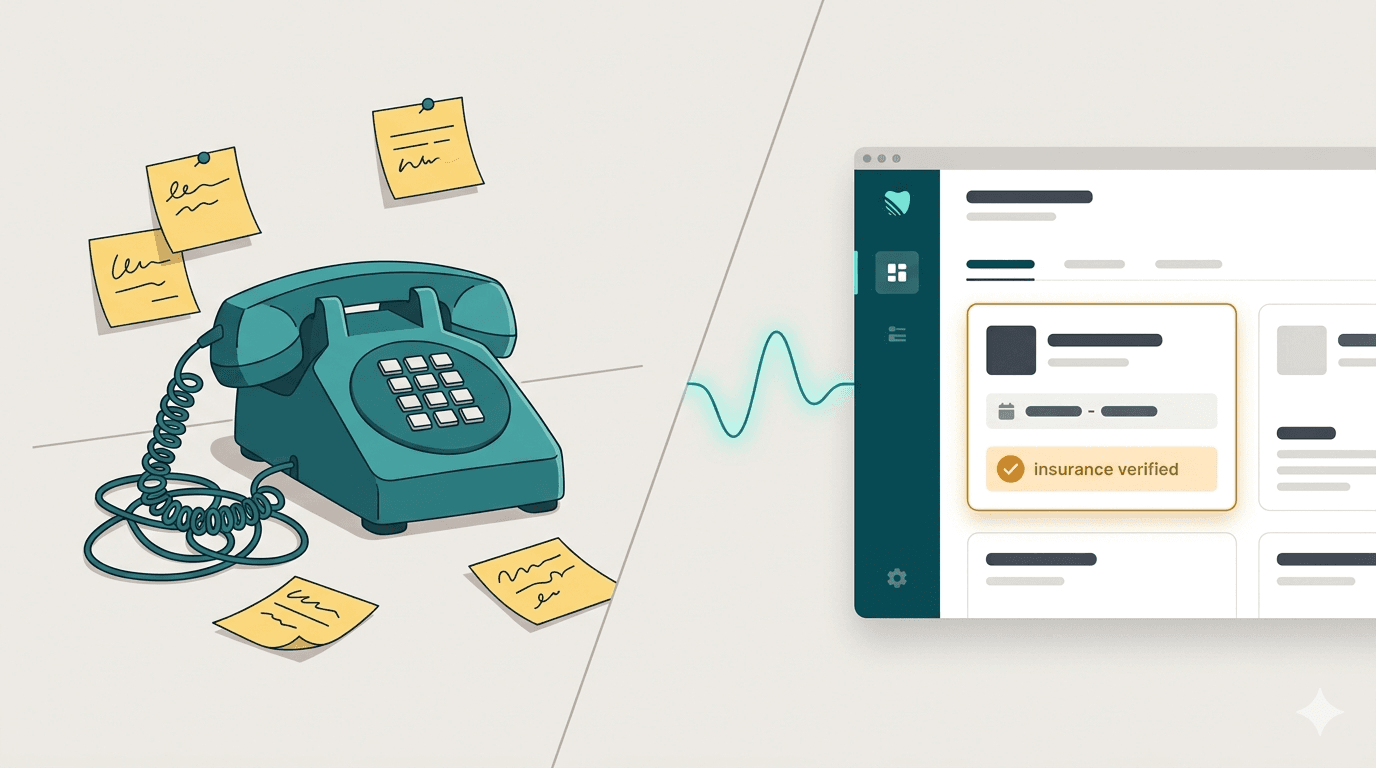
- Traditional orthodontic answering services take messages. They do not book appointments into Cloud 9, Dolphin, or Ortho2. They do not verify orthodontic insurance. They do not know the difference between a bonding appointment and an adjustment.
- Per-minute orthodontic answering services typically run $1.25 to $2.50 per minute plus a monthly base fee — but the real cost is staff time spent processing every message the next morning.
- AI receptionists built for orthodontics book directly into the PMS schedule during the call, verify orthodontic-specific insurance benefits in under 10 seconds, and handle 8+ orthodontic appointment types without training time.
- 75% of patients who hit voicemail never call back. An answering service prevents voicemail but still delays the booking — an AI receptionist closes the loop during the call.
- If your PMS is Cloud 9, Dolphin, or Ortho2, most generic AI receptionists and nearly all answering services cannot write to your schedule. That is the question most vendors avoid answering directly.
- For most orthodontic clinics, the real choice is not answering service or AI receptionist. It is keep losing patients to voicemail or close the booking loop during the call.
Most orthodontic clinic owners have made the same decision twice. The first time was when they signed up with an answering service to cover lunch breaks, after hours, and overflow. The second time was when they started getting pitched AI receptionists and had to figure out whether this was a real upgrade or a repackaged version of the same thing.
The honest answer: it is a real upgrade, but only if the AI actually integrates with your practice management system. Most do not. Most orthodontic-specific workflows get handled the same way an answering service handles them — a message is taken, your front desk calls back the next day, and the patient either picks up or moves on to the next clinic on their list.
This post breaks down what an orthodontic answering service actually does, what an AI receptionist actually does, where the marketing claims do not match reality, and how to tell the difference before you sign a contract.
No affiliate links. No vendor sponsorship. Just a breakdown of two categories of tools competing for the same problem.
What an Orthodontic Answering Service Actually Does
An orthodontic answering service is a human call-handling service that picks up your phone when your front desk does not. The agents work off a script your clinic provides. They collect basic information — name, callback number, reason for call — and send it to your front desk as a message, email, or text notification.
That is the full scope of what most answering services do.
A few higher-end services will attempt to schedule appointments, but there is a catch. They are not logged into your practice management system. They schedule through a separate booking portal or by calling your office directly. The appointment is not in Cloud 9, Dolphin, or Ortho2 until your staff manually enters it the next morning. If two patients book the same slot through the answering service and a front desk team member, you have a double-booking to untangle.
Pricing for orthodontic answering services typically falls in one of three structures:
- Per-minute billing. $1.25 to $2.50 per minute of call time. Monthly minimums apply. A clinic taking 40 calls per month at 3 minutes average runs $150 to $300, plus base fees.
- Per-call billing. $2 to $5 per answered call. Lower cost for short calls, higher cost for complex ones.
- Flat monthly pricing. $400 to $1,200 per month for a defined call volume tier.
On paper, this looks reasonable. In practice, there are three costs that do not show up on the invoice.
Cost one: the morning cleanup. Every message the answering service takes becomes a task for your front desk the next day. If your service handles 50 calls per week, your team is making 50 callbacks. A callback takes three to five minutes per call. That is 150 to 250 minutes of reclaimed front desk time — time that was supposed to be saved by the answering service in the first place.
Cost two: the conversion drop. OrthoFi data shows conversion drops roughly 20% the moment a patient leaves the office without committing, and decays another 35-45% over two weeks. 75% of patients who reach voicemail never call back. An answering service prevents voicemail but still ends the call with "someone will call you back tomorrow." That is functionally a delayed voicemail from the patient's perspective. They do not have an appointment. They have a promise.
Cost three: the orthodontic-specific miss. An answering service agent cannot answer "do you take my insurance?" because they do not have access to your insurance workflow or real-time eligibility data. They cannot answer "how much does clear aligner cost at your clinic?" because they do not know your fee schedule. They cannot triage an emergency bracket break from a routine reschedule. Every one of these questions gets routed back to your front desk.
For orthodontic clinics specifically, the gap widens. Orthodontic patients ask different questions than general dental patients — about treatment phases, retainer replacements, installment plans, age limits on pediatric coverage, and lifetime maximums. An agent in a call center handling 40 different medical and dental clinics does not have depth in any single one.
What an AI Receptionist for Orthodontic Clinics Actually Does
An AI receptionist is a voice AI system that answers inbound calls, handles the full patient conversation, and — depending on the platform — either books the appointment directly into your PMS or takes a message like an answering service.
The difference between "AI answering service" and "AI receptionist" sits entirely in whether the tool writes to your practice management system. If it does not, it is an expensive voicemail with a better voice.
Here is what a real AI receptionist for orthodontic clinics handles on a live call:
- Answers instantly, 24/7. No hold queue. No after-hours voicemail. Weekends, holidays, and lunch breaks covered without staffing changes.
- Identifies the caller. New patient, existing patient, referral, emergency, or administrative. Each gets a different conversation path.
- Collects orthodontic-specific information. Age of patient, referral source, insurance carrier and member ID, reason for visit, preferred provider, preferred days and times.
- Verifies insurance in real time. Both dental and orthodontic-specific benefits — including lifetime maximums, age-out provisions, and treatment-in-progress clauses — returned during the call.
- Books the appointment directly into Cloud 9, Dolphin, or Ortho2. Real-time read of open slots. Correct appointment type (new patient exam, records, bonding, adjustment, debond, retainer check, emergency, TC consult). Correct provider. Correct duration.
- Escalates when needed. Complex clinical questions, treatment plan changes, or billing disputes route to a task for your front desk rather than being attempted by the AI.
- Logs every interaction. Full transcript and recording available in a dashboard. Your team sees what was said, what was booked, and what was escalated.
The pricing model is different from answering services. Most AI receptionists charge a flat monthly subscription — typically $300 to $900 per month for a single-location orthodontic clinic — with no per-minute overage in most cases. The math gets more favorable as call volume grows, because the marginal cost of one more call is zero.
For a deeper breakdown of the five levels of PMS integration and how to tell which level a vendor actually operates at, see our guide on what real PMS integration looks like.
The Category Confusion Most Vendors Benefit From
The AI receptionist category has a marketing problem. Most vendors describe themselves as "AI receptionists that integrate with your PMS." What they mean varies wildly.
There are five distinct levels of integration, from basic message passing to full bidirectional real-time sync. Most vendors operate at Level 1 or Level 2 and describe themselves as Level 4 or Level 5. The practical difference:
- Level 1 (message-passing). The AI handles the call and sends a transcript or summary to your front desk. Your team manually enters everything into the PMS. Functionally this is an AI-powered answering service.
- Level 2 (one-way write). The AI can push an appointment request to the PMS, but it appears as "pending" and requires staff approval before it is confirmed in the schedule.
- Level 3 (read-only sync). The AI can read your schedule to tell patients what is available but cannot book directly. A staff member books after the call.
- Level 4 (real-time write). The AI books directly into the PMS during the call. Patient hangs up with a confirmed appointment.
- Level 5 (full bidirectional sync). Real-time read and write, plus the AI updates patient records, cancellations, reschedules, and insurance data back into the PMS.
Most AI receptionists marketing to dental clinics operate at Level 1 or Level 2. Orthodontic-specific platforms like Orthia operate at Level 4 or Level 5 for Cloud 9, Dolphin, Ortho2, Dentrix, and 68+ other practice management systems.
The test takes under ten minutes. Ask the vendor for a test phone number. Call as a new patient. Book an appointment. Check your PMS. If the appointment is there with the correct type, duration, and provider, it is real. If you have to wait for a callback or manual entry, it is Level 1 dressed up as Level 4.
See how real PMS integration actually works. Call Orthia's live demo line or book a walkthrough and watch an appointment appear in Cloud 9, Dolphin, or Ortho2 during the call.
Head-to-Head: Answering Service vs AI Receptionist for Orthodontic Clinics
| Capability | Orthodontic Answering Service | Generic AI Receptionist | Orthodontic AI Receptionist (Orthia) | |---|---|---|---| | Answers 24/7 | Yes (usually) | Yes | Yes | | Books directly into Cloud 9 / Dolphin / Ortho2 | No | Rarely — most integrate only with Dentrix or Open Dental | Yes, real-time | | Verifies orthodontic insurance during call | No | Rarely — general dental benefits only | Yes, under 10 seconds | | Handles 8+ orthodontic appointment types | No | Inconsistent | Yes, native | | Distinguishes bonding (2 hrs) from adjustment (15 min) | No | Often no | Yes | | Average cost per month (single location) | $400 – $1,200 | $300 – $800 | $399 – $699 | | Requires staff processing after the call | Yes, every message | Depends on integration level | No, appointment confirmed during call | | Patient hangs up with confirmed appointment | No | Sometimes | Yes | | Emergency triage (bracket break, loose wire) | Message only | Inconsistent | Orthodontic protocol native | | Setup time | 1–2 weeks | 2–4 weeks | Under 1 hour (Orthia) |
The numbers matter less than the shape of the table. Everywhere an answering service says "no," an orthodontic AI receptionist says "yes." Everywhere a generic AI receptionist says "inconsistent," an orthodontic-specific one says "native."
What Actually Matters for Orthodontic Clinics
Most orthodontic clinic owners evaluating this decision focus on the wrong variable. They compare per-minute cost against monthly subscription and conclude based on price. The answering service looks cheaper for low call volume. The AI receptionist looks cheaper for high call volume. The decision gets framed as a budget question.
That framing misses the actual value driver.
At $5,500 average case value and a 68% industry conversion rate, the gap between a 65% and 85% conversion rate is roughly $396,000/year in a typical practice. The biggest single lever on that conversion rate is Stage 1 — the inquiry-to-scheduled step. A patient who books during the initial call shows up at a meaningfully higher rate than a patient who takes a message and gets a callback the next day.
The math is not "answering service saves $400/month versus AI receptionist at $600/month." The math is "answering service keeps your Stage 1 conversion at 70% versus AI receptionist moves it to 92%." Run that through a clinic booking 30 new patient inquiries per month and the difference is six to seven additional booked consultations per month. At a 68% consultation-to-start rate and $5,500 case value, that is $25,000 to $30,000 per month in production moved from "potentially lost" to "likely closed."
For a full breakdown of how missed and mishandled calls compound into lost production, see our analysis of the real cost of a missed patient call in orthodontics.
When an Answering Service Is the Right Call
There are legitimate cases where an answering service is the correct tool for an orthodontic clinic:
- You need clinical triage only. If your primary need is an after-hours line for emergency bracket breaks where a human needs to make a judgment call about whether to page the on-call orthodontist, an answering service with a clinical protocol is reasonable.
- You are in a brief transition period. If you are between front desk hires and need 30 to 60 days of coverage without committing to a platform, per-minute answering service pricing limits your downside.
- You have extremely low call volume. A clinic fielding 10 or fewer inbound calls per week may not clear the subscription-cost threshold for an AI receptionist.
Outside of those cases, the answering service model is a bridge to a tool that has not been built yet. For orthodontic clinics in 2026, that tool exists.
When a Generic AI Receptionist Is the Wrong Choice
The AI receptionist market is now crowded. There are more than 15 platforms actively marketing AI receptionist products to dental and orthodontic clinics. Most dental AI receptionists are built for general dentistry and integrate with Dentrix and Open Dental. Orthodontic clinics running Cloud 9, Dolphin, or Ortho2 need native integration to those systems.
This is the quietest failure mode in the category. A generic dental AI receptionist signs an orthodontic clinic, promises full PMS integration, and then the engineering reality becomes clear in the first month. Integration with Cloud 9 or Dolphin is either non-existent or stuck at Level 1 message-passing. The clinic spent hours onboarding, and the workflow is still manual.
For a full breakdown of how the major AI receptionist platforms compare head-to-head, see our dental AI receptionist competition analysis.
How to Test Any Vendor in Under 15 Minutes
Skip the screen-share demo. Those are staged. Do this instead:
Step 1: Request the test phone number. Any vendor that refuses is disqualifying themselves. If they only offer a web simulator, you are not evaluating the actual product.
Step 2: Call as a new patient. Use a different phone than your office line. Give a fake name. Do not tell the AI you are testing.
Step 3: Ask for a specific appointment type. "I'd like to book a new patient exam for my 12-year-old." Watch whether the AI confirms the appointment type correctly.
Step 4: Ask about insurance. "We have Delta Dental. Do you take it, and what's the orthodontic lifetime maximum?" Watch whether the AI can actually answer this in real time.
Step 5: Change your mind mid-call. "Actually, can we push that to the following week?" Watch whether the AI can modify the booking or whether it breaks.
Step 6: Check the PMS. After the call, log into Cloud 9, Dolphin, or Ortho2 and look for the appointment. If it is there with correct details, it is a real AI receptionist. If it shows up hours later or never, it is Level 1 message-passing.
Total time: under 15 minutes. Total cost: zero. This one test filters more vendors than any other diligence step.
The Bottom Line
The orthodontic answering service category exists because for two decades there was no better option. A human call center was better than voicemail. In 2026, there is a better option for orthodontic clinics whose PMS is Cloud 9, Dolphin, or Ortho2 — assuming the AI receptionist they choose actually integrates at Level 4 or Level 5 and handles orthodontic-specific workflows natively.
Most dental AI receptionists do not meet that bar. They were built for general dentistry and optimized for Dentrix. Orthodontic clinics end up with a tool that handles calls but not bookings, or bookings but not orthodontic insurance verification.
Orthia was built specifically for this gap. Direct Level 4-5 integration with Cloud 9, Dolphin, and Ortho2. Native handling of 8+ orthodontic appointment types. Real-time orthodontic insurance verification including lifetime maximums and treatment-in-progress clauses. Setup in under one hour.
Stop paying for an answering service that still makes your staff call patients back. Book an Orthia demo or call the live demo line to test it yourself with a real Cloud 9, Dolphin, or Ortho2 database.
About the author: Olyver Sturdivant is the founder of Orthia AI. Building the future of orthodontic clinic automation.
Orthia answers every call 24/7, books into your PMS, and verifies insurance — so your team can focus on patients. Book a Demo · Call Our AI
Frequently Asked Questions
A properly implemented AI receptionist is HIPAA compliant. The vendor must sign a Business Associate Agreement (BAA), encrypt data at rest and in transit, restrict access to authorized personnel, and maintain audit logs. Orthia operates under a signed BAA with every clinic and is HIPAA-aware across all patient data workflows. Ask any vendor for their BAA before signing a contract.
No, and vendors claiming this should be disqualified. The AI handles inbound calls, bookings, insurance verification, and routine questions. Your front desk team still handles in-person patient interactions, complex treatment coordination, financial conversations, and clinical support. The AI removes the highest-volume, lowest-judgment work from their queue so they can focus on the work that actually requires a human.
They do not, in most cases. Answering service agents are not trained on specific insurance plans, do not have access to real-time eligibility tools, and cannot verify orthodontic-specific benefits. The standard script is I'll have someone from the office call you back about insurance tomorrow. This is one of the most common patient drop-off points in the conversion funnel.
Well-designed AI receptionists have a clear escalation path. The patient can request a human, and the call is either routed to a front desk team member during business hours or captured as a high-priority callback task after hours. In practice, modern voice AI handles the vast majority of calls without patients pushing back. Patient experience data from live orthodontic deployments shows most callers do not realize they are speaking with AI.
Cloud 9 and Ortho2 both offer online scheduling widgets that let patients book through your website. Those are useful but do not solve the phone problem. When a patient calls rather than fills out a form — which is still the majority of new patient contact for orthodontic clinics — the built-in online scheduling does not help. An AI receptionist handles the phone-based booking workflow that the PMS was never designed to manage.
Rarely useful. If the AI receptionist is operating correctly, it captures nearly all inbound calls and books them during the conversation. The answering service becomes redundant. A small number of clinics run both during a 30- to 60-day transition period to build confidence in the AI, then phase out the answering service.
Per-minute billing runs $1.25 to $2.50 per minute of call time with monthly minimums. Per-call billing runs $2 to $5 per answered call. Flat monthly pricing ranges from $400 to $1,200 per month for a defined call volume tier. AI receptionists like Orthia charge a flat $399 to $699 per month with no per-minute overage.
Most generic AI receptionists integrate with Dentrix and Open Dental only. Orthodontic-specific platforms like Orthia integrate at Level 4 or Level 5 with Cloud 9, Dolphin, Ortho2, Dentrix, and 68+ other practice management systems — meaning appointments are booked directly during the call with correct type, duration, and provider.
OS
Olyver Sturdivant
Contributing writer at Orthia AI.
Related Articles
Practice Growth
The Real Cost of a Missed Patient Call in Orthodontics
Read more
Industry Insights
Dental AI Receptionist Competition: Every Platform Compared for 2026
Read more
AI Automation
AI Receptionist with PMS Integration: What Real Integration Looks Like vs. What Vendors Claim
Read more

Industry Insights
Cloud 9 vs Dolphin vs Ortho2: What Your Orthodontic PMS Can and Cannot Do in 2026
Read more
Practice Growth
Your Orthodontic New Patient Conversion Rate Is Probably Wrong
Read more