OS
Olyver SturdivantAI PMS Integration: How AI Tools Connect to Dental and Orthodontic Clinic Management Software in 2026
Key Takeaways
- AI PMS integration is the single biggest factor that determines whether an AI tool works in your clinic or becomes shelfware
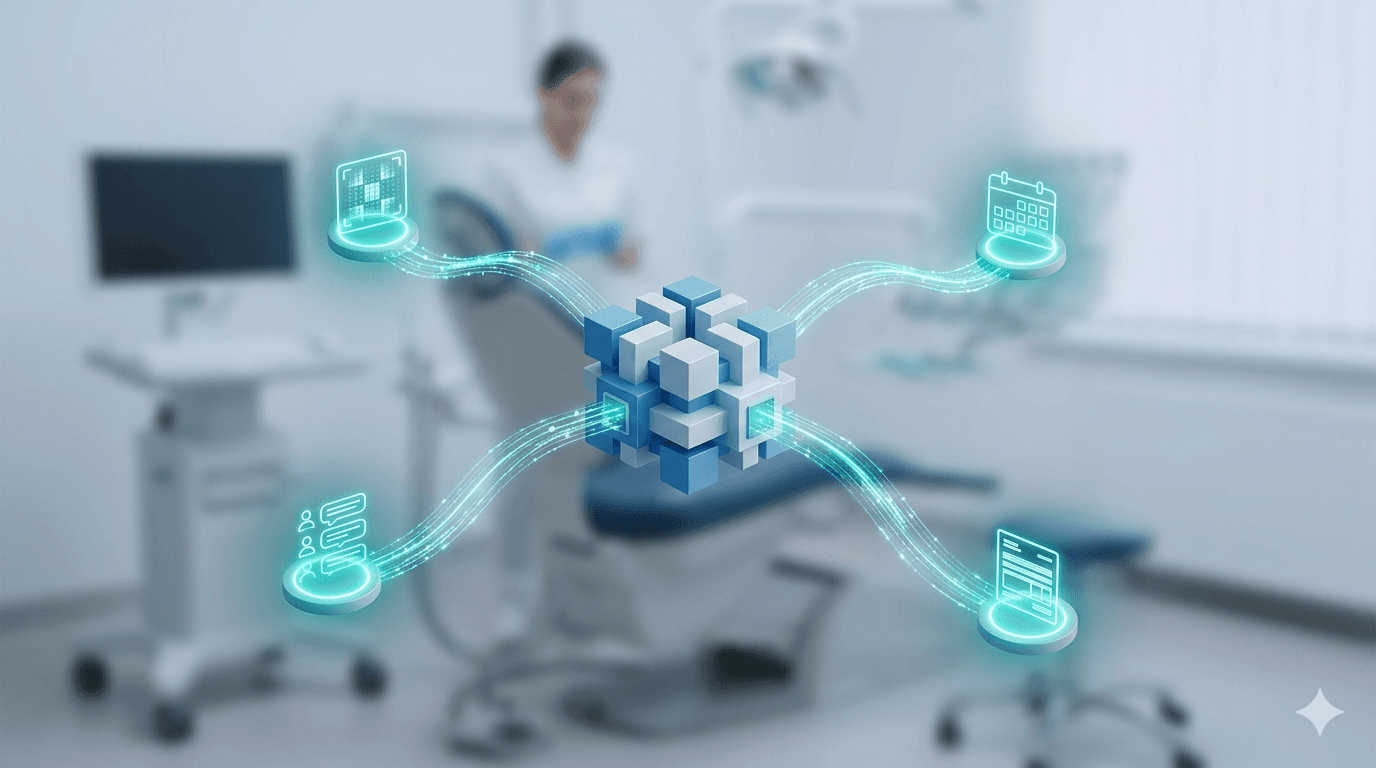
- Four categories of AI tools require PMS integration: receptionists (scheduling), clinical imaging (patient records), insurance verification (eligibility data), and patient communication (recalls/reminders)
- Open Dental is the most integration-friendly PMS; Dentrix has expanded API access; Cloud 9 and Dolphin have capable APIs but far fewer AI vendors have connected
- Orthodontic clinics are underserved — most AI tools prioritize Dentrix, Open Dental, and Eaglesoft because those dominate general dentistry
- Before buying any AI tool, verify integration with your specific PMS — ask what data the AI reads, what it writes, whether it syncs in real time
The dental and orthodontic AI market in 2026 has no shortage of impressive products. AI receptionists that sound remarkably human. Imaging AI that detects pathology in real time. Insurance verification tools that pull eligibility in seconds. Patient communication platforms that automate recalls and reminders.
But here is the problem most clinics discover after the demo: if the AI tool does not integrate with the practice management system you already use, it becomes another disconnected piece of software. Your staff copies data from one screen to another. They toggle between the AI dashboard and the PMS. They re-enter appointments, re-verify insurance, and reconcile patient records manually. The AI saved 3 minutes on one task and added 5 minutes of data entry somewhere else.
PMS integration is not a feature. It is the prerequisite for every AI tool to deliver value in a dental or orthodontic clinic. Without it, AI is a demo. With it, AI is infrastructure.
The Four Categories of AI That Need PMS Integration
Category 1: AI receptionists and scheduling. Answer calls, book appointments. Integration means real-time schedule read and direct appointment write. Without it, the AI takes messages staff must process manually. This is the most integration-dependent category.
Category 2: Clinical imaging AI. Analyze radiographs, CBCT scans, intraoral images. Integration means accessing patient imaging records and writing diagnostic annotations to the chart. Companies like Overjet and Pearl have built integrations with major platforms.
Category 3: Insurance verification AI. Check eligibility, pull benefit details. Integration means reading patient and insurance data from the PMS, querying payers, and writing results back. For orthodontic clinics, the AI must pull ortho-specific data: lifetime maximums, age-out provisions, treatment-in-progress clauses — a process that takes 10x longer than general dental verification when done manually.
Category 4: Patient communication AI. Automate reminders, recalls, follow-ups, review requests. Integration means reading appointment data, accessing treatment history, and updating communication preferences. Bidirectional sync (patient responses update the PMS) significantly reduces staff time.
How Every Major PMS Handles AI Integration
Open Dental — Most integration-friendly PMS in the market. Open-source with well-documented RESTful API and direct database access. More AI tools integrate deeply with Open Dental than any other PMS. If a vendor cannot integrate well with Open Dental, that signals limited engineering resources.
Dentrix — Most widely used PMS in North America. Henry Schein has expanded API access through a credentialing program. Both on-premise and Dentrix Ascend (cloud) support integration, but APIs differ between versions. Most major AI vendors have Dentrix integration, though depth varies.
Eaglesoft — Widely used, integrates through Patterson's API framework. Some AI tools achieve Level 4 (real-time read/write), others limited to Level 2. Verify write capability specifically.
Cloud 9 Orthodontics — Popular cloud-based ortho PMS with API support. Cloud architecture makes integration technically straightforward, but far fewer AI vendors have built connections because the orthodontic market is smaller. Verify your vendor has active Cloud 9 integrations in production, not just "planned."
Dolphin Imaging and Management — Combined imaging and practice management for ortho. Integration landscape is limited. Most general dental AI tools do not connect to Dolphin. If you run Dolphin, integration capability should be your first screening criterion.
Ortho2 Edge — Cloud-based ortho PMS with growing API capabilities. Like Cloud 9, technically feasible but underserved by vendors focused on the larger general dental market.
Curve Hero — Cloud-based, used by both general dental and ortho. API supports scheduling and patient data. Several AI vendors have built integrations, depth varies.
Denticon — Cloud-based from Planet DDS, used by DSOs and multi-location groups. API supports scheduling, patient management, and reporting.
The Integration Gap for Orthodontic Clinics
The pattern is clear: the more a PMS is used in general dentistry, the more AI options exist. The more a system is orthodontic-specific, the fewer vendors have invested in connecting.
General dentistry has ~150,000 practice locations in the US. Orthodontics has ~12,000. AI vendors build for Dentrix and Open Dental first because the addressable market is 10x larger.
The result: a general dental clinic can choose from a dozen AI receptionists with deep integration. An orthodontic clinic running Cloud 9, Dolphin, or Ortho2 might have two or three options with genuine deep integration, and many more vendors that claim "integration" at Level 1 (message passing). For a detailed look at what real PMS integration looks like versus what vendors claim, we break down the five levels of integration depth.
This gap is compounded by scheduling complexity (8+ appointment types), insurance complexity (lifetime maximums, age limits), and patient record requirements that general dental AI tools don't handle.
Orthia was built to address exactly this gap — native integration with Cloud 9, Dolphin, Ortho2, Dentrix, Open Dental, and 60+ other systems, with orthodontic scheduling logic and ortho-specific insurance verification built in from day one.
How to Evaluate AI PMS Integration Before You Buy
Identify what data needs to flow. For receptionists: schedule read + appointment write. For imaging: radiograph access + finding documentation. For verification: patient demographics + insurance data + results. For communication: appointment data + treatment history + preferences.
Ask the vendor to name their integration level. Level 1 (message passing), Level 2 (cached read), Level 3 (cached read/write), Level 4 (real-time read/write), Level 5 (full bidirectional). Vendors at Level 4-5 are eager to explain the distinction.
Verify with your specific PMS. "We integrate with 50+ PMS systems" does not tell you about yours. Ask for a demo on your system.
Ask about active practice count. A vendor with zero active practices on your PMS is untested. That should come with a shorter commitment and lower price.
Test bidirectional sync. AI books → appears in PMS. Staff changes PMS → AI reflects update. One-directional is common. Bidirectional is rarer and far more valuable.
Ask about downtime and fallback. What happens during API outages? Does the AI switch to message-taking? Go silent? The behavior should be defined, not improvised.
What Happens When Integration Is Done Right
Scheduling becomes a closed loop. Patient calls at 8 PM, AI answers, checks real-time availability, books for Thursday at 10 AM with correct provider, creates patient record, confirms via text. Monday morning — appointment on the schedule. No voicemail, no callback, no manual entry. For a step-by-step walkthrough, see our guide on how to set up an AI receptionist for your orthodontic clinic.
Insurance verification becomes proactive. AI pulls data from PMS, verifies eligibility and benefits before the appointment, writes results back. Treatment coordinator sees complete information before the patient arrives.
Patient communication becomes automatic and accurate. Recalls and reminders fire from actual PMS data. Confirmations update the PMS. Cancellations trigger waitlist offers. No staff intervention at any step.
The common thread: deep PMS integration eliminates manual handoffs between systems. Every handoff is a chance for delay, error, or data loss. Removing the handoff doesn't make the task slightly faster — it removes the task entirely.
Sources: Pearl AI PMS integration guide (2026); Overjet dental AI (2025); Savvy Agents PMS integration (2026); DentalBase AI comparison (2026); Arini call flows (2026); Dental Economics technology adoption (2025); OpenLoop Health dental automation (2026).
Frequently Asked Questions
AI PMS integration is the connection between an AI tool and your practice management system. When properly integrated, the AI reads data (schedules, patient records, insurance) and writes data back (appointments, verification results, notes) without manual intervention. The depth varies dramatically by vendor and PMS platform.
Open Dental has the most options due to its open-source API. Dentrix has strong support from most AI vendors because of its large installed base. Eaglesoft offers integration through Patterson's API. Cloud 9, Dolphin, and Ortho2 have capable APIs but significantly fewer AI vendors have built deep connections because the orthodontic market is smaller.
The general dental market is ~12x larger than orthodontics. AI vendors prioritize Dentrix, Open Dental, and Eaglesoft first. Additionally, orthodontic scheduling and insurance verification are more complex than general dental workflows, requiring additional engineering that generic vendors are not incentivized to invest in.
Yes. Cloud-based systems (Cloud 9, Dentrix Ascend, Curve) handle API connections through cloud infrastructure for faster setup. On-premise systems (Dentrix, Eaglesoft, Open Dental) require local server configuration but don't affect daily performance. Most AI vendors support both architectures.
Cloud-based PMS: under an hour. On-premise PMS: a few hours for credentials and configuration. The AI vendor should handle the technical work. If setup takes weeks, the vendor is either building from scratch (you're a beta tester) or using complex middleware rather than native API.
Clinical AI (imaging, diagnostics) accesses imaging data and writes diagnostic findings. Operational AI (receptionists, scheduling, insurance, communication) accesses scheduling, patient demographics, insurance data, and appointment status. Both need PMS integration but access different data and support different workflows.
Any AI tool accessing patient data through PMS integration must comply with HIPAA — BAA required, data encrypted in transit and at rest, access controls and audit logs maintained. Proper integration with proper agreements does not create a HIPAA problem.
Three options: choose a different AI tool that supports your PMS, ask the vendor about their build timeline (be cautious about 'planned' integrations), or use the tool at a lower integration level with manual workarounds. The third option is rarely worth it for AI receptionists because manual work negates the value.
OS
Olyver Sturdivant
Contributing writer at Orthia AI.
Related Articles
AI Automation
AI Receptionist with PMS Integration: What Real Integration Looks Like vs. What Vendors Claim
Read more

Orthodontic Operations
Which Practice Management Systems Work With AI Receptionists?
Read more
Industry Insights
AI Ortho: How Artificial Intelligence Is Reshaping Orthodontic Clinics in 2026
Read more